Friday, February 12, 2016

WEYERMANN BARKE PILSNER (TM) GRAIN GIVE AWAY... CONTEST!


We're taking a break from the yeast series for a day and we are having our first real give away!   Not a corny everybody wins give away.   An actual contest.  The amazing people at BSG have donated 10lbs of Weyermann Barke Pilsner TM malt to Counterbrew for a contest.   And one of you lucky readers will get to try this amazing grain for free. No cost, nada, zero, zippo... no postage, no handling... just free.    The runner up will win 1# of some other German Specialty malt, that we have here at Counterbrew!  An undermodified pilsner that can be used like a carapils.  Also cool stuff.

They want you to try this amazing Pilsner, and after using it a couple of times, I want you to try it too.  This is simply put the best Pilsner malt I have ever used, and I brew a lot of german lagers.   It extracts better than any I have tried, and the flavor is ridiculous.

So... how do you win?   it's easy you write.   You post a comment about how home brewing has impacted your life in a positive way.  Talk about friendship, talk about experiences, talk about tasting and appreciating beers.   Members of the counterbrew team are excluded from competition and will be helping to judge the entries.   Members of other blogs, are not excluded from this contest.  So bring your A game.  Cause, some of those guys can really write!

One more thing.  Don't be a douche!  Don't write "cuz me and my brahs have a sh*t ton of brewskies fo cheap, and the ladyz lovz the brewski"

The rules are simple.  Post in the comments section below.   The entries will be judged by the crackpot counterbrew team (me, John, MA, and Jake).  The winning entry will be selected by our impression of the entry.  Nothing more.  The contest will be open for one week.   Our decision will be final.   The winning entry will be posted on Counterbrew.   The winner will be contacted and the grains will be shipped to the winner. If you don't have a mill, let us know, and we'll mill it for you.  

Counterbrew wants to thank the people at BSG for their amazing support.  BSG is committed to home brewing and to home brewers.

Thursday, February 11, 2016

THE ACTUAL TRUTH ABOUT YEAST: Volume 1 with Kevin Lane of Fermentis

Brewers make wort,
Yeast makes Beer!
The old adage is that "brewers make wort, yeast makes beer" and that is true.  Despite all of your best efforts you can not make beer with out the help of these miraculous little critters.   Of all of the things we deal with as brewers, mashing, hop additions, water chemistry,  chilling and dreaded off flavors,  yeast is perhaps the least understood, and the most researched.

In truth you don't really have to understand yeast to make great beer.  In truth you could never fully understand yeast.   You can literally study it for your entire life and never learn all there is to know. Heck, they offer PhD's in yeast studies.   What did you think a PhD in microbiology was?

But to become a great brewer, to consistently make world class beer, you need to know at least the basics about yeast.  So, I am teaming up with Kevin Lane of Fermentis.  To do a three or four part series on yeast.   The series will be presented as a question and answer format.   It will have straight answers on yeast.  Yes, it is from one of my trusted sponsors.   Yes, it may have a decidedly "dry" yeast slant.  But It will also have loads of good information.  The first question and answer is called, "yeast basics".

Remember, a big aim here at Counterbrew is to dispel some of the common wisdom (read as misinformation) about home brew.  With the growth of the internet, you can easily source all kinds of good information about home brewing.   There are hundreds of articles available for free online that are credible and educational.  Unfortunately, there is also so much bad information about brewing out there. Much of that bad information is released by good, intelligent, caring people who are trying to show you all a "best practice".  Not a Law of Brewing.  Here are some examples of questionable information.
  • The need to heavily aerate or oxygenate your wort.- they don't need as much as you think.  You don't need 60 seconds of pure o2. 
  • The need to ferment lagers under 50 F (10 C) - I've used 34/70 for years at 62 F (16.66 C) No off flavors and several awards.
  • The need to pitch a huge volume of yeast every time - sometimes you want stressed yeast. yes sometimes you want more off flavors.
So, to dispel some of the mis-information.   We go straight to the source, Kevin Lane,  Technical Sales Manager of Fermentis.   Anything I added is italicized. 

What is yeast?
Louis Pasture the actual father of
modern brewing.
Yeast is a microorganism that is part of the Kingdom Fungi.  The Kingdom Fungi is a group of Eukaryotic organisms (membrane protected organelles) that have the ability to function as a unicellular organism.  Yeast are not plants and are not animals or bacteria.  They are similar to animals in the means of digesting food by absorbing and breaking down food to receive energy.  Brewer’s yeast was discovered in 1876 (Louis Pasteur) and has been applied to brewing beer as a pure yeast strain selection since 1883.


What does yeast do?

Yeast survive.  Their entire reason for doing what they do is to survive and to create new generations to succeed themselves!  In their attempt to survive, they consume food (sugars) for energy and grow in population (by digesting proteins and amino acids as well as trace components).  Their digestion of sugars creates alcohol, CO2, heat and other trace chemicals that we recognize as flavors and aromas. (trace chemicals are a small % of output, but huge impact on the flavor of your beer)


Why does yeast do what it does?
Yeast ferment (digest) to provide energy for themselves.  The chemistry is very complex and the metabolic pathways for nearly every chemical the yeast produce has been mapped out.  The easiest way to describe what the yeast is doing is by analyzing the ATP synthesis via their metabolic pathways.  The real answer to why yeast does what they do is very simple: they live!  They are living, breathing (in aerobic environments), eating and sexing (asexual) machines! (fungi not really machines)

What is a metabolic pathway?
A metabolic pathway is the means by which an organism metabolizes (processes) chemicals.  For yeast, the metabolic pathways describe the breakdown of sugars, proteins and any other chemical compound that they transfer through their cell wall and digest.  If you google yeast metabolism, you will find many visual diagrams, showing the many metabolic pathways

This is one of my favorite chemical pathway maps to show people.  I received it from a good friend, Alex Combe, who I worked with in the pilot brewery at MillerCoors.  It really shows how complex yeast are and how many different pathways they control for the production of different components.  (very sciency and complex but if you want a pdf, let me know)


So yeast converts sugar to Alcohol, and CO2, and creates a range of other by products.  What are these other by products?
Do you really know how to prepare
a wort for real Belgian flavors?
The other by-products are any of the intermediates in the diagram of the biochemical pathways.  It can be said that most of the intermediates are only present for a short period of time, while the yeast are going through the biochemical pathways, but they are still present and therefore can be released from the cell, due to many factors.  The main by products that we are brewers are concerned with impart flavor and aroma to the beer.  With that said, the main focus is usually on esters and off flavors.  It is important to note that certain flavor and aroma compounds (ex. 4VG {phenolic}) are only possible if the wort supplies the precursor (in 4VG production, the precursor is ferulic acid) and the yeast need to have the genentics to produce the compound (again with 4VG, the yeast need to carry the POF+ gene {phenolic off flavor positive}). (very important points made here, hop you all caught them... if you want a phenolic spicy Belgian beer better make sure you get ferulic acid in your wort... here's a hint you have to step mash!)

So the other by products of fermentation contribute a lot to the flavor of a beer. How can home brewers increase or decrease these by products?
There are many factors that can contribute to increased or decreased expression of the by products.  There are simply too many to list and there are still some unknown factors that yeast producers/providers and Universities are investigating.  The major contributors are: pitch rate, fermentation temperature, OG, pH, fermenter design (tall, narrow vs. short, wide), open fermentation, etc.  The key to remember is that if you change one of those parameters, there is a chance that the yeast will perform differently.  In the yeast world, we refer to these as environmental conditions and the brewer is there to attempt to create the environment that the yeast will perform best in.  Most of the parameters come down to stressing the yeast (ex. if you under vs over pitch, if it is a cool environment or a hot environment.  A metaphor could be made that yeast are very much like humans, in these regards: if you are stressed, bad words come out of your mouth (at least they do out of mine).

There is a lot of emphasis on the role of oxygen right now in home brewing, can you talk about that?
This is a very interesting topic.  There is a lot of confusion in home brewing as to the needs and demands from yeast.  Yeast need oxygen to produce sterols that are part of the cell.  They need oxygen to reproduce and to live a healthy life.

That being said…
I can only speak for Fermentis and that is what my intention is here.  Our yeast are produced in fully aerobic environments that have sugar and nutrients dosing.  We propagate our yeast with the idea that we want the yeast to be as healthy as possible, when the brewer (whether home, craft or industrial) purchases it.  We move immediately from propagation to the drying process, which is quite extensive (5 stages and each strain has a different recipe to make sure it remains in peak condition).  With that, our dried, packaged yeast has enough sterols and oxygen demanding components to reproduce 10 times without any oxygen present in the wort!  We have performed trials to analyze this and have the results.  Does that mean you should try to make oxygen deprived wort?  No.  Does that mean that you don’t need to be concerned about the oxygen?  To some extent.  The idea that I want to get across here is that Fermentis provides you with a “safety blanket”.  The yeast is already able to reproduce 10 fold, so there isn’t a need to be pumping a bunch of oxygen into your fermenter or being concerned about the DO levels.  (basically quit stressing about Dissolved Oxygen, Shake it up, hit it with a little o2, use an aquarium pump, but don't obsess over the dissolved oxygen it will be fine RDWHAHB  I should point out to you skeptics that Brulosophy has tested this misnomer.)

There is also a lot of emphasis in home brewing on proper pitch rate of yeast,  how can a home brewer know they are pitching the right amount of yeast?   Does Fermentis offer a calculator?   Does Fermentis have a viable cells per sachet list or resource? 
Wort Rehydration of Fermentis
t598 and s33
Another very good, but difficult question to answer.  The difficulty isn’t in the later questions; the difficulty is in the first question regarding “proper pitch rate”.  I would like to remind you that yeast is not an ingredient, it is a living organism.  With it being a living organism (and I will reference back to the question about by products), if you put the yeast into a different environment, they will act differently.  Is there a proper pitch rate?  My answer is no.  The beauty of brewing is that you can change the flavor every time you brew and end up with different beers based on a few changes.  The end results are up to the brewer’s opinion of what they want.  If everyone reading this were to try the same 20 beers and list them from best to worst, we would likely all have a different order.  Some beer drinkers like IPAs, some like Stouts, some like phenolic flavors and some hate phenolic flavors.  It is important to remember that you as a home brewer, are able to create the beer that you want and that you think is the “bees knees”.

Back to the question, Fermentis recommends a pitch rate range: for ales we recommend 50-80g/hL(grams/hectoliter)  and for lagers 80-120g/hL.  Remember that a standard home brew batch of beer is just shy of 20L so we recommend 10-16g for ales and 16-24g for lagers.  Does this mean that you need to stay within those recommendations?  No, you get to do what you want! (important point here,  you might pitch more or less yeast depending on what you are trying to accomplish)

The other tricky thing about this topic is that people have been hypnotized by liquid yeast, to the point that they always want to know cell count.  For liquid, that is the best way for you to measure the amount of yeast you are adding.  For dry yeast, we recommend a biomass pitch rate (weight/volume).  If you read the bottom of our technical data sheets, we state that if you pitch at 100g/hL, you will achieve 6 mc/mL.  That pitch rate is above the recommended rate for ale’s but the reason is as I stated before, our production procedures and the health of our yeast in the package.  We do not have a list of the viable cells per sachet, but we have done time trials and have found that annually you will lose about 5% of the viability if the sachet is stored in a refrigerator and 10% if the sachet is stored at ambient temperature!!!  Our yeast now has a three year best before date.  

Can brewers reuse yeast?  There is lots of talk about washing or rinsing yeast and using it again and again.  
Can brewers reuse yeast?  Good question.  Simple answer is yes.  I always remind people that dry yeast is yeast, we have just processed it so that it is shelf stable and the brewer doesn’t have to worry about doing a starter a day or two ahead of when they want to use it.  The difficult answer is “yes, but be careful”.  Remember that yeast is living and that every time yeast reproduces (buds) and creates new cells, there is a possibility of genetic mutation.  These mutations can happen 10-20 times in one fermentation and can lead to a colony of yeast that is genetically different than what you started with.  The “be careful” part of my response is related to this fact.  Additionally, every time you reuse yeast, you introduce the possibility of introducing an infection: bacterial or wild yeast.  With all of that said, you can reuse yeast and our company recommends 4-6 generations at the most. (my personal suggestion is no more than 3 times and handle it as little as possible, Ill post again soon about pitching onto yeast cakes in progressive OG beers)  When reusing yeast, you have to do it knowing that you may end up with different fermentation kinetics and the possibility of different flavors coming from the yeast.  This could be a good thing or it could be a really bad thing.  If you want consistent beers every time, it is best practice to start with a new package.  Remember that when commercial breweries reuse yeast, they have a team dedicated to yeast handling and they have the ability to acid wash the yeast (homebrewers can too, but it is a lengthy, difficult process) to kill bacteria and yeast that aren’t capable of surviving the acidic environment.


If a brewer re uses yeast, how many times can they use it before it mutates?   

It depends on the environmental conditions and the strain its self.  Some strains mutate faster and others slower over the course of fermentation and growth phases.  It is hard to say how many times, because some strains will mutate the first time and others won’t for multiple generations.


What is the importance of temperature controlled fermentation?   Which is more important control or consistent temperatures?

Temperature controlled fermentation is similar to using a new yeast package every time.  The control is for consistent results for duplicating the beer.  It would be the same as asking, “what is the importance of using the same amount of malts in the recipe” or “the same amount of hops at the same times”.  If you change the fermentation parameters, you will change the outcome.  Sometimes, you won’t see a difference, but other times you will.  Both control and consistent temperatures are the same.  Neither is more important, they both play a role in fermentation. (get a fermentation chamber, or two)

Best advice for new and intermediate brewers?  Sanitation, Fermentation, Oxygen, Dry yeast?

Best advice I can give is…

Remember that as a brewer, you aren’t making beer.  You are attempting to make the “right environment” for the yeast to produce the beer you are wanting.  You are only able to control the wort before the yeast goes in.  Once the yeast is pitched, the yeast do the work.  REMEMBER this!  Everything you do in cleaning, sanitizing, brewing, fermentation controls and parameters… all of that is for the yeast.  Brewers are essentially glorified cleaners and “pet” caretakers.  Humans don’t make beer, ONLY YEAST CAN (with the exception of GMO organisms, but that is a very different conversation)!

Great stuff from Kevin Lane.  And there is more to come sports fans, so check back as we continue this series on The Actual Truth about yeast!

Prost!

Monday, February 8, 2016

The end is near. .. la fin du monde clone

My first "la fin du monde", I remember it like it was the other day.   Not a clear perfect memory, like a memory from yesterday.  More hazy and romantic, like the memory of your first kiss.  We were sitting in a friends back yard comparing beers.  It was a cool summers evening,  there was a gentle breeze stirring the leaves on the patio.  The light from the candles reflected back off the underside of the outdoor umbrella made a golden halcyon cloister for our beer tasting.  My buddy Mike had brought a "Dragon's Milk" (which I knew and loved already) and a weird tripel from a Canadian Brewery.  Being a fan of Belgian Beers, and never having had one made in North America that I though was up to snuff (other than home brewed efforts)  I begrudgingly took a sample.   Boy were my misconceptions erased.  Erased with one sip of that flaxen honeyed elixir.  I was hooked.

I am a fan of Unibroue and especially of La Fin du Monde (the end of the world).   But I am not a fan of the $13 price tag for a 22 oz.  Here in Kansas City.   The solution... make it myself.    On Saturday, the brew crew and I set out to do just that.  Opting for a partial mash version of this beer.   We all love partial mash.  It is really an excellent method for home brewers.  It eliminates many of the variables that can screw up your beer.  I have already written several posts on partial mash.    Check them out if you want to learn more about it.


I ground the grains early brew day morning hoping for maximum freshness from our grains.  This batch of beer featured all Cargill Grains.  IdeaPils, and Wheat Malt.  Cargill makes some excellent malt.  But they aren't as prevalent in home brewing.  So ask your LHBS to get it for you.  I'm a fan of IdeaPils for everyday beers made from pilsner.  So I started early, but I wasn't the first one to start working on this beer.  John had already started the night before.  He started by treating 5 gallons of our needed 7.86 gallons of water with half of a crushed Camden tablet.   If you aren't pre treating your water, you should be.   High levels of chlorides can keep your yeast from attenuating completely.   Camden is an easy solution.

Taste your mash
Trust me, youll know
when it's ready!
My fledgling brew crew is really getting to be good.  The brews we are making now are better than most commercial, and reaching competition quality. ( If you're unaware, competitive brewers make some of the best beer in the world.  So find one, and learn from them. )  We have learned a lot of things in the past 90 days, now we are learning about water chemistry adjustments.   We blended our tap water with distilled water an added back in the minerals we were lacking with additions of gypsum and Epsom salts.    Our pH was perfect at 5.2-5.3.  Remember this is a partial mash, so pH isn't as big a deal, but still damn good.

One shorter, one long
We have a pretty damn
good idea of the temp
We step mashed this batch starting with a protein rest and then a saccrification rest at 154 for 60 minutes.  At the end of 60 minutes we added 1.5 gallons of 190 F water in which we had dissolved our DME.   This brought our mash to 168 F where we rested for 10 minutes.  We then sparged with a little over a gallon of water to go to volume.  We were at 1.055.  A little low, but we still had 2# of honey to add to the boil, and evaporation from the boil..  Sytrian Golding hop additions were at 60 and 15 minutes.   The color was amazing.  Our  sg for this beer... 1.084 exactly where we wanted to be.

Vitality Starters
Perform like any other
yeast starter.
At the beginning of brew day we made a vitality starter. Our new most beloved trick.  4.25 cups of water and 1 cup of DME.   Into this we pitched a package of S33 and T58.  Both Belgian strains from Fermentis.  I find the combination of the strains gives the more accurate flavor of the La Fin Du Monde yeasts. T-58 is peppery and spicy,  S-33 gives a touch of the phenolic belgian flavors. Neither is as "belgiany" as Abbaye.   The yeast vitality starter has the entire brew day to get going, and boy does it get going.   in 4.5 hours there was a .5" krausen forming in the Erlenmeyer flask.

2 coils makes chilling
so much faster.
We chilled the batch with both wort chillers, and even though it was February we were able to chill outside.  The batch chilled in 13 minutes, from 200 to 65.    We aerated heavily with the aquarium pump for 20 minutes.   Then pitched our yeast vitality starter.  And put on a blow off tube. And thank goodness, we did...

John reports that while he and his lovely bride were out for the afternoon,  The yeast took off like crazy.   By midnight he was thankful we put the blow off tube on.  He reports, on Sunday morning the following... "holy freaking blow off, bat man".


"The end is near tripel"


Jake transfering
the mead
5.2# of Cargil IdeaPils TM
2.5# of Wheat Malt
.3 #  of Biscuit
.3#   of Aromatic
3# of Pilsnen DME
2# of Honey
1.3 oz of Styrian Golding at 60 - 6.76 AAUs
1 oz of Styrian Golding at 25 - 5.2 AAUs
1 tablet Whirlflock
1 tspn yeast nutrient

1 pkg of T-58 
1 pkg of s-33

We also made some more mead.  Mead is easy to make.   And you have plenty of wait around time during your brew day to make a batch.  You really should give it a try.

Wednesday, February 3, 2016

End the Arguing... No more trolls

It's time to end the argument.  We all won anyway.   At the end of the day we all had beer.  Beer to share, beer to enjoy.  Yummy delicious beer.   So quit freaking arguing over how to make it.  Sometimes I feel like a broken record.  But here we go again. 
  • Wort production method doesn't matter
  • Barley doesn't know how it is being mashed
  • Someone else's method may be better, or worse than yours
  • The important thing is, that it is fun, and that it makes great beer. 
  • If you spent $1000 on wort production before fermentation temperature control, you missed the point!

So is time to quit telling others that the way they brew is wrong.   Or that they are less of a brewer because they use a particular method.   You aren't more of a brewer if you use 3 or 4 vessels, you aren't more of a brewer if you use the latest state of the art eHERMS or RIMS system with a vent-less water heater and a bluetooth controller (although that is pretty cool)  You aren't less of a brewer if you no sparge in a cooler, or biab.  Enough. already! If you make beer, you are a home brewer.   

What prompted this latest rant?  A troll. A lecherous wart covered, dung eating troll with tusks and leathery skin.  The kind of beast that should be driven out of the kingdom (summon Arthur and the knights)... the internet troll.  

You know the type,the type who changed his on line name to "mstrbrewr" after his first Mr Beer kit.   Since then he's managed to brew a couple more times, but he has read and committed to memory everything.    His un welcome answers to questions are straight out of the books he's read. But not from his vast practical experience.   He's full of knowledge and passion for this hobby,  and he just had to share it all, now! Share it from his lofty position on the old couch in his mom's basement. 

Tonight a guy on one of the forums made a pretty innocuous comment about 90% efficiency with  brew in a bag.   The conversation was pleasant, until Tommy Troll chimed in.  He explained to all of us that "this was not possible".   He quoted Palmer, he quoted Fix.   What he did not do is show any compassion or share any experience.   He attacked.   In his dully honed opinion, "only fly sparge  could get a person to 90%."  Despite several people letting him know they had done it several times.   He then proceeded to explain that biab is "much less efficient". And I had had enough.  He was desperate to display his knowledge. To establish his prominence in the brewing community.  He is, after all, the new brew sage we have been waiting for.  

So here we go again.  There isn't one right way to brew.  Even commercial brewing is changing, many do not even have HLTs or Grants any more... opting instead for instant water heaters.  If you open your mind you'd know that.   My team and I are building a 1 BBL BIAB Recirculating Mash system.  You are welcome to use it (for a nominal fee) when you need to brew big, Are you really going to say no, because it's BIAB?

I am a classic example, and I was a classic fool.   I resisted biab for years.   I knew beyond a shadow of a doubt that my fly sparge system was the most efficient way to make beer.  I knew my system so well that I could coax 78-80% out of it.   But on a cold and snowy day I joined a friend who was brewing in his kitchen with an electric turkey fryer. All grain BIAB.  Winter / Kitchen brewing was something I couldn't do.   We got 83%.  I checked, and re checked.  I tasted the mash, perfect.  I rechecked the mash extraction efficiency.   There was no where to hide.  I had to admit it worked.   I now get 82.5% efficiency consistently with brew in a bag, on my kitchen counter top.   But please,  yes. Explain to me how only fly sparge is real  brewing.   Because I was doing that before you were born. 


The world changes,  and we change with it.  By the way arguing about wort production... kinda misses the point.  I have correctly and precisely fermented average wort at perfect temperatures, and produced superior beer.  Once again malt has no idea it is being mashed.  Enzymes couldn't care less whether you biab, fly sparge, batch sparge, or no sparge.  After 3 or 4 years, of brewing you're ready to have really helpful experienced advice.  But not after 1 or two years of just reading and studying. Be kind. Be helpful, share your actual experience.  And remember almost everyone has read, and owns the books you are quoting.   If the real answer was in the book they would have found it already.   So don't sit around with the books in your lap trying to answer questions.    Believe me we've all read the books.   Ask questions.  

And finally, we don't need a new sage... but we could all use another beer loving friend. 

Monday, February 1, 2016

Busy Beavers Brew day...

Sunday after church Mark and John came over for a brew day.  But it wasn't just a brew day.  We also had to bottle 10 gallons.  And the guys wanted to make some mead.   So that, sports fans, is a full day. 

We brewed a hoppy wheat that John designed.   Not super bitter but lots of late hops and dry hops.  Should be a fantastic spring / summer beer. 

We also sampled lots of the light ales we have been making.   When you learn the tricks, you can drop a clean ale out like a lager and make realistic clones of lagers with out the need for a lager fridge.  I must say the Stella clone is excellent. It would be as good as any beer we have made, but we also tasted the BDSA... more later.    

The brew day went smoothly.  The only thing that was forgotten, was the 5.2 pH stabilizer.  But I snuck in a pH check and the pH was 5.7 after 15 minutes, so I didn't worry about it.  

Man does wheat foam... it foams during the mash, it foams during the boil, it foams on Christmas, it is probably somewhere foaming now.  John and Mark worked hard to manage boil overs.   

Chilling beer with a single coil sucks.  I have gotten spoiled by the two coils.   It doesn't just take longer.  It takes way, way longer.   Temperature change is not a linear reaction.  That is why when you are chilling you go from 212 F to 110 F Fast and then fight for the remaining 40 degrees. 

I for one, will not be chilling a 5 gallon ever again with a single coil.   Two, 25 foot coils will chill a batch in about 12 minutes.  It took us 30... and that sucks.  And that wastes a lot of water.  One planet, one chance.  

We made a vitality starter again.  This time with good ol' US05.   This is great yeast.   And it is our favorite choice for a hoppy wheat.   Good attenuation,  mild fruity esters, decent flocculation.  Good stuff.   The krausen had begun forming with in hours.  As of this morning it was bubbling like mad.   You just Gotta love Fermentis.

I'll post more about the mead in another post, but let me just say.   You can easily make 1 gallon of cider, wine, or mead on your brew day.  They are all so much simpler than beer.   If you can make an extract batch of beer you can make mead.   The only down side of mead, is that it can take 6 months to a year to be really ready.   A great resource for mead is "storm the castle".  He is a trip.   And he has an entire page on mead.  But if you want to learn to make a catapult or a sword, he can teach you that too.  You should really check out his page... Let's just say if a zombie apocalypse ever happens... this guy is surviving.   Got Mead is also great stuff.


After the brew, we set to the arduous task of bottling 10 gallons of beer.   We brew together.  So bottling is the best solution for us.  Makes beer easier to share and divide.   We bottled a bohemian lager that tastes great, and dropped all the way to 1.007 from 1.050.  And we bottled a Belgian dark strong ale that we have been aging on French oak chips.  This is really the best beer I think we have ever brewed.  I'm confident that it would do well in any contest.   We may save enough to enter it in a few.  Bottling is a breeze with 3 guys who know what to do... we were done in 40 minutes. 

Next weekend we're brewing again.  Don't know what yet.  There are some exciting developments which may effect our choice of what to brew.  More on that later sports fans. 


Friday, January 29, 2016

Strawberry Wine... seventeen... a cold winter day, dreaming of spring


Forgive the title of this post... but Dena Carter...yeah... ok..
So step mashing is a long process.  But it definitely improves your beer.  The flavor of a step mash, or decoction mash for that case is more... grown up.  Not commercial, mind you, just more refined.   Yes, I know it isn't necessary.   Yes, I know most malts are fully modified now...  But a step mash ensures that all phases of the conversion are addressed.  And when brewing a Belgian Abbey style it is absolutely necessary if you want to enhance the production of ferulic acid and therefore create more phenolic flavors....


So why am I talking about a step mash in a blog that is clearly focused on Strawberry wine?  


Here's why,  Step mashing takes so long, that if you are step mashing, you easily have time to make a 1 gallon wine kit, or 1 gallon of fruit wine.   And that is exactly what Mark and I did last Saturday.  And you should too,  if you can make beer, trust me, you can easily make decent wine.  In another post Ill talk about wine expectations, and wine snobbery.   You can make world class wine at home, but do you really want 30 bottles of some amazing oaky, complex cabernet?   Come on, you're a beer guy...or gal... or person... Not a wine snob.


During the mash,  Mark and I took 4 lbs. of frozen strawberries, and 1 lb. of frozen mixed berries.   Why did we add frozen mixed berries... cause that's what SWMBO brought home.   We added all of the berries to a stainless brew pot on the stove and slowly thawed and heated them to 160 F (71 C) for 10 Minutes.   It isn't strictly necessary to pasteurize frozen berries, but it doesn't hurt anything, and because you'll be letting the berries hang out in the must for a few days, it is a good idea.   

Making wine is easy.  And if your SWMBO is like mine, she isn't much of a beer person, wine is a great alternative.  Just do your self a favor from your very first batch.   Forget all wine snobbery.  Make drinkable,  easy to make, fast to ferment good wines.  I like fruit wines, and the 1 gallon wine expert kits.   When I do make a 6 gallon wine kit, it is usually something very easy drinking like, white zinfandel, or one of the Island Mist Kits.  They're delicious, and ready in 4 to 5 weeks.   Nothing blends better with Saison, than a country wine.  An important thing to remember.  You will get better and better as you learn more and more.  Just like brewing, your first couple of batches will be good, but maybe not great.  But trust me,  after a couple of batches your understanding will grow and you will be on your way to excellence. 

Here's a recipe for an easy Strawberry Wine

Ingredients

Before sugar
Addition
  • 4 – 4.5 pounds strawberries Frozen is fine. 
    • I usually go 4 pounds of strawberries, and 1 pound of mixed berries,  the color is fantastic.
  • 1 gallon water
  • 2 - 3 pounds corn sugar to a OG of 1.080 minimum. 
    • I like strawberry wine sweeter so I usually go to 1.100...
      • Won't the yeast eat all the sugar?... depends on the yeast.   But even if it does, you can back sweeten wine.   Easily...
  • 1 teaspoon acid blend
  • 1/8 teaspoon tannin
  • 1/2 teaspoon pectic enzyme
  • 1 teaspoon yeast nutrient
  • 1 Campden tablet - for when it's time to stop the fermentation.
  • 1 package Côte des Blanc or champagne yeast (can substitute regular wine yeast)
  • 1 Package of Sparkaloid... or lots of patience... It can take months to clear.
    • I generally just wait.  1 gallon is 5-6 bottles of wine.  If you make 1 or two a month you'll be swimming in wine.
 Instructions
  1. Wash and remove the stems and leaves. 
    1. if using frozen this is done for you already.  I just slowly bring the fruit and1 gallon of water to 160 for 10 minutes.   And I mash it up with a potato masher.
  2. Use a straining bag and fill with the crushed strawberries. Tie the top, and leave straining bag in a sterilized bucket.
  3. Add water if needed, sugar, and acid blend, tannin, pectic enzyme, and yeast nutrient. Stir well.
  4. Before you add the yeast, you will need to sterilize the must. Crush up one Campden tablet and add to the must. Stir and cover for 24 hours. Now you may add the yeast. Stir well, cover, and stir every day for 4-5 days.
  5. Then siphon into your 1 gallon jug, put the rubber stopper on and airlock.
  6. It will take about 2-3 months before your wine is clear enough to bottle.
  7. You can make more than just 1 gallon if you just multiply out the recipe. 
    1. I used half a pack of yeast for this batch.
Other questions


Can I use other fruits?  Of course, just about any fruit can become wine.  Even garlic... yup... it's gross.  But Apples, Pears, Grapes, Apricots, Strawberries, Raspberries, Blackberries are all easily done.


How do I learn to make other fruit wines?  Well first you understand that winemaking is a process.   Kind of like brewing is a process.  But in wine making the quality of the ingredients are very important.  It took me a long time to realize that the strawberries from Wal-Mart were actually better for wine making than the strawberries from WholePaycheck market.

Where can I learn more? Not surprisingly, Beer and Wine Journal is an excellent resource.  As well as this article written by Beer and Wind journal editor Chris Colby for Grit Magazine.


That's all for now sports fans.
Prost!

Tuesday, January 26, 2016

Pilsner Ale... With Fermentis K-97 and Weyermann Barke Pilsner (TM)

Saturday Mark Anthony and I brewed a Pilsner.  A crisp refreshing American Pilsner.  The penultimate easy drinking beer.   We used 7# (3.17 kg) of Weyermann Barke Pilsner (TM), and .5# (.22 kg)of Flaked corn.  The batch was hopped with 2 charges of Hallertauer at 60 and 15.   We were shooting for 25 IBUs and a gravity of 1.044.   A little hoppier than most American Pilsners, but that is what we wanted.  Crisp and reminiscent of a German pilsner.  There was only one weird thing going on, as far as we knew,  we were using an ale yeast by Fermentis called K-97.  More on that amazing yeast later.


What we got was a 21 IBU,  1.050 batch.  That is ridiculous extraction from the grains.   That is 88.64% Mash efficiency.   Brew house efficiency of around 86 to 87%.   Now, I generally get in the 80%.  I set my recipe calculator for 82.5%, which is my normal efficiency ever since I switched to BIAB.  But... 88%  Something was different.   

We crushed fine like we always do, I set the mill to a little more than the thickness of a credit card.   We doughed in low.  Having never used the malt before we wanted to give ourselves the best possible chance at success.   We step mashed beginning with a protein rest at 135 F (57C) for 20 minutes, then a slow step up to saccrification at 149 F (65 C) for 40 minutes, then a slow rise to mash out at 168 F (75.5 C) for 10 minutes.   The mash took a while, 95 minutes.  But we sampled beers, and discussed our travels, and plans.   We are about to brew some beer for an upcoming ethnic festival and there was considerable planning to do. There has been a lot of emphasis on speed in brewing recently.   My question for you is why?   Yes, excellence can take a long time.  Yes,  your brew day may last for 5 or 6 hours.  But many of you dream of "going pro" someday, so you can be assured if you ever do, you'll remember fondly the old 6 hour brew days.  

We tasted the mash at the beginning of the saccrification rest.  We didn't use iodine today,  because I need to get more.   I have said before, your mash takes what ever time it takes.  I stand by that.  Most mashes are done long before 60 minutes.  So we taste at 15, 30, and 45.   In this case at 40 minutes.   The mash tasted amazing.  I'll trust MA to make a comment to back me up on this.  Probably the best mash I have ever tasted.  

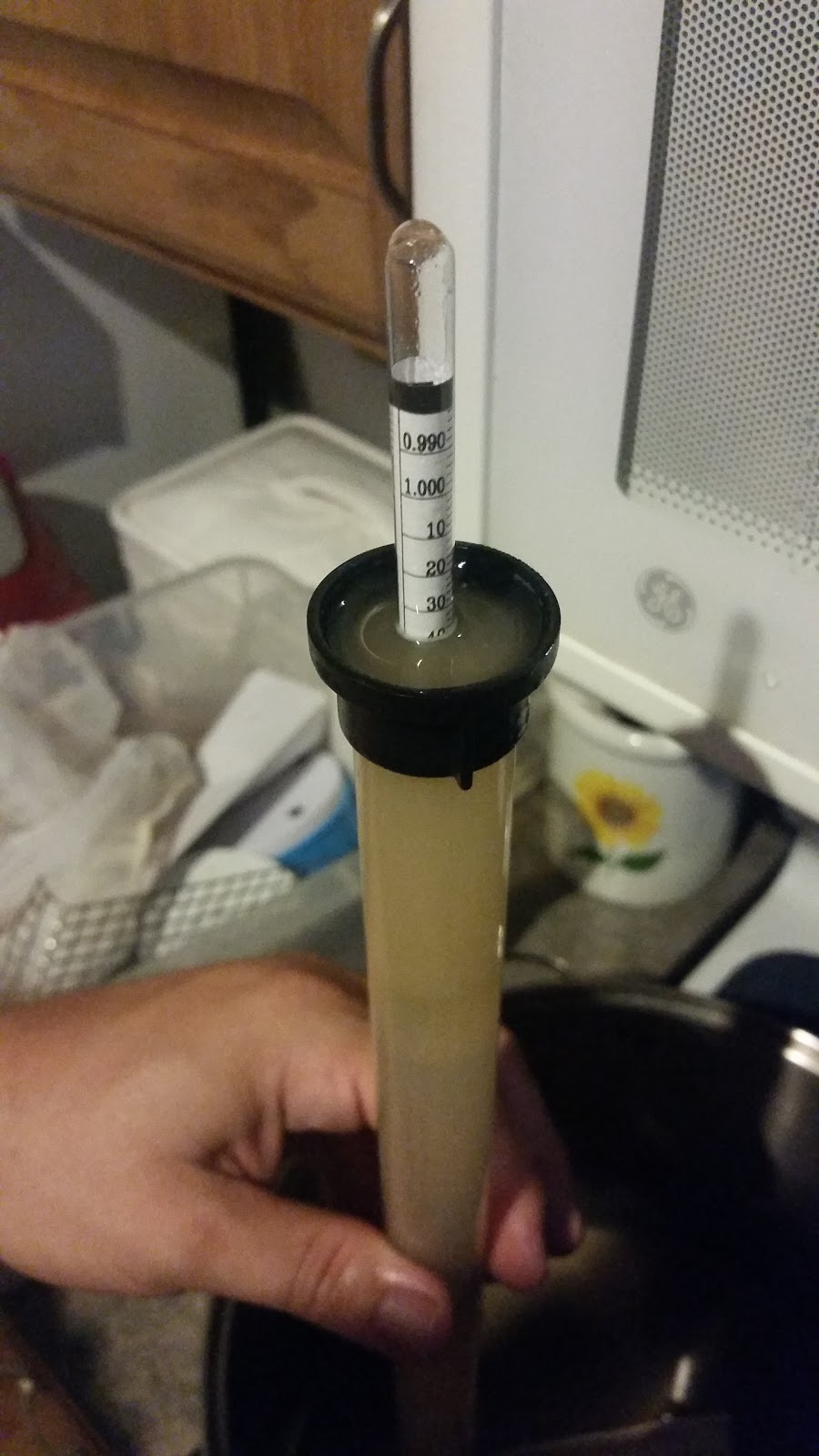
That is when things got weird.  Our gravity sample was 1.039.   What the What?     We had overshot.  And I never miss my gravity.  Gravity samples are boring for me.   Listen, I'm not saying I'm the best brewer in the world.  I'm not a multiple NHC winner or even a state champion, I'm just a really experienced home brewer.  I hit my damn numbers.   So what changed.   The malt.   You see, for everyday pilsners, I am a fan of Cargil IdeaPils.  Good malt for single step saccrification. I Still use it, used it Sunday as a matter of fact.   But this, Weyermann was amazing stuff.   This is clearly a German Government Secret Malt.  This is nuclear powered pilsner malt, there can be no other explanation.   I just don't overshoot by that much,  even with a long careful step mash.     If you have access to Barke Pilsner (TM) by Weyermann I suggest you go get it.   Get all you can.   Mortgage your dog, make your wife give plasma... just get some.  The extraction and flavor are excellent. 

But this day was really about a yeast experiment.   If you've read my previous post, you know I am a lover of clean crisp refreshing beer.  Not BMC conglomerate beer (although I respect them) something a little more flavorful.   But still very drinkable.   You also know that I have been searching for years for an easier method for making "lager like" beers.   Now, having said that I have the ability to lager.   I have a mini fridge, and a rudimentary temperature controller.   Soon, Ill have a chest freezer and 2 inkbird controllers.  So Ill have an ale chamber and a lager chamber.  But I still search for that perfect yeast that can make a lager like beer.   Today, we were trying Fermentis K-97.   K-97 has only recently become available to home brewers.   It has been used for years in commercial breweries. Safale K97 is an ale strain that when used correctly and at consistent correct temperatures will attenuate at or above 80%, and will produce very little ester, only about 23 ppm in a 1.074 wort at 68 F (20 C)  That is amazing.


To give ourselves the very best chance at a clean fermentation we made a starter, kind of... you see for years Fermentis recommended making a starter.  They said you could make it with sterile water or with a very low gravity wort.   The idea was to get the cell walls of the yeast pliable again prior to pitch.   But then the boys in the lab said,  "rehydration is not necessary with most beers" and confusion was instantly created.   I have a series coming up with Kevin Lane of Fermentis where this will be covered in detail.   At the beginning of brew day, we pitched the dry yeast onto a 1.035 starter at around 85F.   We let it sit as we made the beer.  

By the time we were ready to pitch we had a fantastic yeast starter.   Easy,  if you can make beer, you can follow this method.   I'm pleased to tell you the beer took off and was forming a krausen with in 6 hours.   That is very similar to the performance I observe when I make a starter with liquid yeast.    Here is an easy way to make a starter.   4.25 Cups of water, 1 cup of DME.   Bring to a boil.  Chill to around 85F.   Pitch the yeast.  Do this at the beginning of brew day.


Bet you blizzard boys
wish you had an
electric turkey fryer
this week?
Back to the brew.   We made 1 ounce hop additions at 60, and 15 minutes.  The wort was amazingly clear by the end of the brew day.   We boiled in my electric turkey fryer with the lid on but ajar by about 2".   And again the obligatory, "no I'm not concerned about DMS, I have covered that adnausem on this blog... well modified malts, very little risk... blah blah blah...."  We made our hop additions and our other additions.  At the end of our brew day we chilled the batch, aerated,  and pitched the starter.   I for one cant wait to try this beer.  it is fermenting in a 62 to 64F (16 - 17 C) environment right now. 


That's all for now sports fans.


Prost.

Easy links


Weyermann Barke Pilsner Malt  accept no substitutes, Weyermann is the only provider of Barke Pilsner Malt (TM). 


http://www.fermentis.com/brewing/industrial-brewing/product-range/ yes I know it says industrial product range, but trust me, they have it for home brewers now too.