Showing posts with label double india pale ale. Show all posts

Friday, April 8, 2016

Unleash the beast... HOPTONITE Brew night!

It has been promised to you for a while.   It has been hinted at in cloistered conversations around the water cooler. "When are those idiots going to brew the ridiculous dIPA we were all promised?"  Well, brew fans your wait is over.   Because last night in Johns garage, we brewed the Hoptonite dIPA.

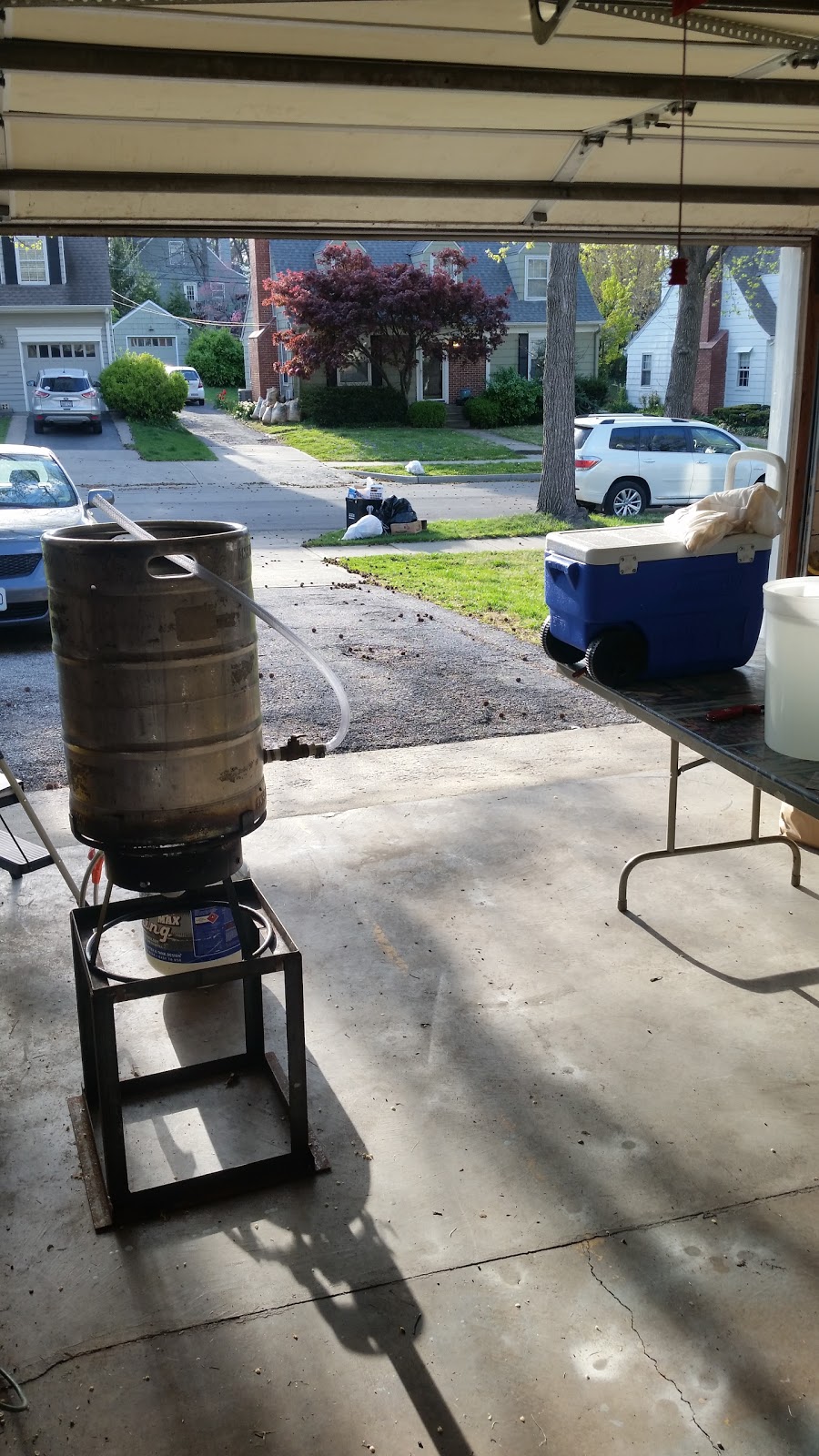
It was a beautiful night here in Kansas City.  A perfect night for brewing.   We set out to brew a 5 gallon batch of Hoptonite.   Our process was very straight forward.   A simple single infusion no sparge brew.   I personally love no sparge brewing.   We do our no sparge brewing in cooler mash tuns.   You have seen the pictures of the 100 quart mash tun that we use for 10 gallon batches.    But tonight we were using my 48 quart good ol reliable mash tun.   I've had it forever.  It still works fine. John preheated the mash tun with hot water as we ground the grains.

I made the water adjustments.  This was our first time using Beer Dust IPA blend. I'm sure it is a fine product, but it was not able to buffer to where we wanted, or reduce the pH adequately. Looking forward to seeing how it impacts the finished flavor of the beer.  So we used some acidulated malt, and some Five Star 5.2.  We nailed our pH.   Well ok, not nailed, but pretty damned close.

Our hops were provided by the awesome people at BSG.  We got to try their small packaging, and let me tell you,  it is every thing they say.  These are the freshest hops we have used... ever.  When you are making a hop monster ask for small packaged hops.  The major hop companies have them.  Your LHBS can order them for you.

Our grains all came from Cargill.  Cargill malts are fantastic.  I am definitely a fan.  We use grains from Rahr / BSG and Cargill.   I know when I stick with these companies, I will get consistent quality. Tonight, our base grain was Cargill 2 row pale.  We had heard rumors as to it's quality taste and high extraction.  Wort samples were sweet, bready, nutty, and delicious.  Everything we heard was true.

We were targeting 152 F as our mash temperature.   After checking the grain temperature and doing a quick calculation on brewtoad.com, we knew our strike water needed 8.5 gallons of water to be at 160 F.   We nailed our mash temperature.  At dough in we briefly rose to 153 F, but after taking the pH we were at 152 F.  We lost only 1 degree during the 60 minute mash, another benefit of no sparge.   If you have never tried no sparge brewing, you really should.  There are just really very few disadvantages, and lots of advantages.

Consider the following advantages of no sparge.
  • Decent efficiency, we get about 77%
  • No dough balls - thin mash easy to stir
  • Easy partigyle.   If you want to make two beers in one day, this is the easy way.  
    • Make a high gravity wort, drain it, and then put new water in for your second batch.  You can even add new specialty grains for flavor and color.  
  • Easy brew days, no sparging, heating water for sparging, transferring water.
  • More "time" in your brew day to do other things. 
    • organize
    • clean
    • prepare hop additions
    • sample "Founders KBS!"


At the end of the mash, we opened the valve on the cooler and drained into the boil kettle.  The first addition of hops went in right then.  4 ounces of Centennial. From there on it was a circus of hops.  We normally put hops into a bag, but this time we decided to let them flow and move about freely in hopes of maximizing their impact on the beer. 

We use a dry erase marker, Tupperware, and disposable cups to organize our hop additions.    Organization is critical when brewing a complex hop monster like this one.  Fortunately Jake is kinda uber organized.  So he takes charge of getting the hops ready.   Tonight that was no easy task.  The photo was taken after a couple of additions had already gone in.  

The boil was an awesome sight and smell extravaganza.   The entire garage filled with an intense hop aroma.  Not the normal, hoppy goodness aroma, this was intense.  The boil was rigorous.   We collected 7.5 gallons of wort, and boiled down to 6 gallons.    Next time, we will use a paint strainer bag for the hops.   The wort was a chunky hop soup.  It has already settled, and we have the technology to deal with it along the way, a quality fermentation chamber.   We can cold crash with out moving our fermenter.  But if you don't have that technology, use a hop bag.

We chilled as always with our Jaded Hydra chiller.  To say that it is awesome is an understatement.  We wanted to get under 140 F, as quick as possible.  And then whirlpool for 20 M.   We definitely pulled that off.  We went from 220 F to 120 F in about 2 minutes.   Amazing.  After the whirlpool, we went from 110 to 67 in 2 minutes.   Just get a hydra.  You'll thank me.

The next step for this is a whole lot of dry hops.  We are estimating a  3 week fermentation on this one.   So first dry hops go in in a week.   The rest of the dry hops go in the day before we begin the cold crash.   This is, as you may remember a real key to getting the hop flavor and aroma you want.

So in a month, we will be drinking an absolute hop monster. Drinking it along with august hyppo, and pliny the petulant.  I guess we are pretty well set with IPAs for the summer.   As you may recall we also brewed up 10 gallons of saison recently.  5 of which will be ready soon.  And saison is great summer beer.   Half of the batch was pitched with a sour culture, so it wont be ready for a year.  Up next for the group is probably the PIVO pilsner clone, with a partigyle IPA.  We have the grains, and the hops so why not?   I know at the high heat of summer our attention will turn to fall beers, a Festbier, a pumpkin ale (I know, I know, but the girls love them), browns, and stouts.

UPDATE 4/13/2016 - Hoptonite had a blow off of epic proportions.  Mark Anthony and I went to Johns to bottle up the Pliny the Petulant, and discovered a foamy hoppy mess in the fermentation chamber.  It took us (mostly MA) over an hour to clean it up.  So, use a blow off tube people.  Smells like intense hops, cant wait.


Saturday, March 12, 2016

How to make a ridiculous dIPA; Part 3 Recipe design. with BSG Hoptonite dIPA

So now it is time to apply what we have learned in this series and design a ridiculous double India Pale ale.   Our goal is not to clone any particular dIPA but rather to be inspired by some of the dIPAs that we love. We are not nearly as concerned with IBUs as we are with hop flavor and aroma.  IBUs are a theoretical measurement of bitterness.   We want the beer to be bitter, but we are more focused on hop flavor and aroma, and definitely a tongue stinger.  I, for one, think this is a fundamental characteristic of a dIPA.  We want loads of hop flavor and aroma.  We want those aromas to be herbal, pine, citrus, black pepper, and a touch of stone fruit.   Notice I didn't say woody, earthy, floral or grassy.   Those are characteristics we associate with an English IPA.   We want the color to be very light for a dIPA 7.5 to 8 SRM.


Wowser, that is a lot of want's and things to consider.  So let's break them down and analyze them one at a time.
  • We want the beer to be bitter -  We have learned that IBUs are a measurement of bitterness not hop aroma or flavor.  A beer that is 70-80 IBUs can be intensely hoppy.  But we promised you a hop monster. Were shooting for 135+ IBUs.
    • We have learned that many brewers prefer bittering hops low in cohumulone to get a less harsh bitter.   So We will be using Nugget Centennial - more later.
  • We have learned that by choosing hops with certain oils and protecting those oils by not exposing them to isomerization, and boil off, we can maximize our hop flavor and aroma.
  • We have learned that we have to focus on certain oils to get certain flavors.   In our case those oils are high in Myrcene and Linalool, and have a fair amount of Humulene and Carophylene.
  • We will need a decent bittering charge to get our IBUs up.
    • When you hop the heck out of a beer and have no bitterness, it just kinda seems mildly fruity and citrusy on the tongue.  That isn't what we want here.  
      • We made an all late addition citra IPA.  it was... meh. No balance just citrusy and stone fruit.
  • We will need a mid boil addition to up the bitterness more and get some midrange flavors.
    • Otherwise our beer can taste like it has a hole in the middle.   Bitter, but not lingering, and then whamo! aroma and flavor.  We want flavor and aroma all the way through the pallet. This is really common with lots of commercial american IPAs
  • We will have some flame out additions in our batch, but remember we have a jaded  hydra chiller and can easily control how long the oils are subjected to high heat. If you do not have the ability to chill rapidly.  I would suggest chilling to 140 F, then adding the hops for a 20 minute hop stand. 
  • We will be using 2 charges of dry hops in this recipe.  
    • One large charge of dry hops during active fermentation to expose the oils to bio transformation.  We want the transformation of the linalool into citronella 
    • One smaller charge of dry hops right before bottling to protect the oils from bio transformation during active fermentation. 
  • The hops we have selected were generously provided by BSG.  BSG is freaking fantastic.  They also have a small packaging program that keeps hops fresh.   Ask for BSG.
    • Side note:  They are the force behind many of the grains and hops you already use.  
    • Additional recipe support was also provided by the great people at BSG.  
  • The hops we have selected are
    • Centennial
    • Nugget
    • Galaxy
    • Cascade
    • Citra
    • El Dorado
    • Mosaic
  • Our hops came in 1 ounce  oxygen evacuated packages from BSG.  Your local home brew store can order these for you.  Our hops were shipped cool, and have been stored in the freezer. 
    • If your local home brew store does not have oxygen protected hops, and you are brewing for contest, or just trying to make the ultimate batch.  have them order these for you.  Both of the great hop providers, BSG, and YCH Hops can provide these for you. 
Again, we didn't want to copy another recipe exactly.  We wanted this to be our own Counterbrew / Turkey Creek / Mynd Spyn / Borders Brewing Adventure recipe.  Sure we could have just copied Pliny the Elder, or Headdy Topper.  And let me say for the record that is a fine thing to do.  I personally love Pliny the Elder.   I make it a lot, a couple of times during this writing of this blog. But this is our beer, based on our new and deeper understanding of the hops.  It is our hope that this new understanding creates a fantastic beer.

But now comes the hard part.

Figuring out the additions, the times, and the processes.   For that we turn to two sources to which I am proud to introduce you. (see I can use correct grammar)  First,  ScottJanish.com  hop oil calculator.  Scott is a great guy and very cerebral.  He has taken the time to build a free online hop oil calculator.  We have been testing it, and the predicted results match very closely the final product.  Now, you should know our hop bill doesn't fit into scotts calculator very well.  We  are using some hops that have not made their way onto the calculator yet.  No problem.  Not only is Scott cerebral, he is also a good guy.  He helped us choose the closest substitutions for the sake of his calculator.   The end result.  We will kinda know what the beer will taste like before we brew it.

Second, is good ol' expert advice.  One of the great things about home brewing is you can turn to people in your club, your LHBS, and to industry guys for help.   We will be planning our recipe using Brewtoad.com and Scottjanish.com.  And then sending our recipe to the experts at BSG just to make sure what the computer is spitting out will match what experience and expertise indicates.

ScottJanish.com is a beer blog.  Scott has done the research for you.  On ScottJanish.com you willfind the very best commercial clone recipes on the net.  A list of the top 200 beer blogs by reported traffic.  (Sadly we haven't made the list yet, but were almost there.) A list of great home brew recipes.  A hop substitutions engine, which is ever growing and expanding and, last but certainly not least, a hop oil calculator.   I don't design hoppy beers any more without consulting scottjanish.com.   The first beer was our hoppy wheat.  The hoppy wheat was barely posted about.  But we designed the recipe using the hop oils calculator, and as I sit here enjoying one right now, it occurs to me, the engine was right on the money.   We were trying to make a hoppy, citrusy wheat beer with some pine notes.  That is exactly what the engine said we would get, and that is exactly what we got.

But designing this recipe is a little more challenging.  The hop oil calculator does not have every hop yet,  Scott is doing his best, but remember this is just an amateur home brew blog. Not amateur in appearance or performance, just in the fact that it is not Scotts full time profession.  Since we were Using some hops that are not in the calculator yet, we had to find the closest substitution hop and plug that in.

When I first put the recipe in I was convinced of a hop schedule that featured Nugget as our bittering hop.   Nugget fit the bill.  I was sure of this fact.  But, I have come to trust Scott's hop oil calculator.  And when I put in my hop bill I got something that looked like this...Mild and pleasant with spicy floral tones.... what the what?   I'm trying to make a tongue stinger.   A tongue stinger that features very lemony, citrusy, pine, and black pepper tastes.  Here was my first attempt.

That is not what we were trying to do.   Mild and pleasant?   What is this the Lawrence Welk of beers?    We want interesting and cool.   We want flavors you can identify when you drink the beer.  But that is the cool thing about ScottJanish.com.   It allows you to test your recipe before you brew.  And based on the knowledge we have accumulated about hops, you can adjust your recipe.  Which I did.  Here is the second attempt.


Citrus and lemon notes with cedar, pine, floral black pepper and subtle green melon.  "Hello! yes please Ill have two of those, and get the dame a cosmo please, thank you!"  That is exactly what we wanted.   So that is what we are going with.    Just to make sure, before we brew, we will be running this by some experts at BSG.  But I think you all get my point.  What a cool resource.  One little change.  Changing the initial bittering charge to Centennial makes all the difference.  And isn't it cool that we live in a time where we don't have to just keep making the same beer over and over to figure that out?
So now our final recipe looks like this.
5.5 Gallon Batch.   Yield 5 gallons.
OG - 1.081
FG - 1.012
ABV - 9.1%
IBUs - 142 - yup 142 percieved IBUs but total AAUs of 160.85  (Pliny is 199 percieved IBUs and 152 AAUs)  So this is an insane hop monster.


The mash is a simple 60 minute rest at 150 F.    We will certainly do a no sparge for ours, but you brew it however you want to.  You could even make this as an extract.  There is so much hops in this that you really wouldn't notice much of a difference.   We wont be mashing out, or sparging, or step mashing or anything complicated.  Just straight forward hop attack.   That is it.  Nothing more to this one.   It is all about the hops.  We will be turning on our Jaded Hydra right at after the flame out additions go in.  We will be under 140 F, in under 2 minutes.  The 2 day dry hop is not a typo.  For the final dry hop we don't want to expose the hops to any yeast activity.

Next stop Brewing the beast.   But before we brew, remember we are running it by our experts.

So that is it sports fans.   A true hop monster.  But a hop monster developed with thoughtfulness and technology.   I am not saying this is the final version of the recipe.   I am sure we will make adjustments and modifications as we brew this beer.  But for now, this is our version of a double IPA. The brew day photos and videos will have to wait a while. As we are all very busy right now.   With family coming into town, work travel, church, and school activities.   I for one can't wait to brew this beer.   We will also be making my "by Grace" IPA in the near future (the best IPA I have ever tasted, an entire 5 gallon batch disappeared at just 2 cast parties)  and John's cream ale.  It is a fantastic summer beer. Thank you for your comments and questions.   I hope you will also brew this beer, and tell me what you think of it.

If you need an extract version of the recipe.  Just substitute the entire grain bill for 9.9 lbs of Light Liquid Extract (not pilsen or Maris Otter, just standard extract) and 2 lbs of extra light DME.   We are working with a home brew supplier to bring you all pre packaged versions of our recipes.  More on that to come soon.

UPDATE:  The good folks at BSG think our recipe looks good, and want to try some when it is done. We'll make sure they get to.

UDATE 2 Hoptonite will have to wait for a couple of weeks.  Easter is coming fast.  We have convinced our SWMBOs to let us brew on Holy Saturday, but it has to be fast.  So were doing a 10 gallon no sparge Saison.  Hoptonite will not be a fast brew day, every detail will be checked and re checked when we brew the monster.

UDATE 3 Hoptonite is about a week old.  It is chugging away in the FC.  The whole basement smells like hops.  We had a slight blowoff, and by slight I mean it took over an hour to clean up, so use a blow off tube and a large bucket.    Cant wait to taste it.

Friday, March 11, 2016

How to make a Ridiculous dIPA volume 2 - Hops, with Chad Roberts of YCH HOPS


This is a long one, but it's worth it. 

"Furthermore, we wish to emphasize that in future in all cities, markets and in the country, the only ingredients used for the brewing of beer must be Barley, Hops and Water. Whosoever knowingly disregards or transgresses upon this ordinance, shall be punished by the Court authorities' confiscating such barrels of beer, without fail.

There it is, the Reinheitsgebot.  The first of many laws governing how beer was to be made. What?  you don't care for the Reinheitsgebot? You are a free brewer, and you'll add what ever you want to your wort...  OK, cool, I'm cool with that.  But,  understand, this is where the use of hops became not just common, but also standardized and regulated.   And thank god it did.   From this point on hops were the key defining flavor of beer. Hops became the flavor that separated one style from another.  

When you back up to 50 yards away and watch a brew day.  They all look very similar.   Water, malt,  hops, and yeast.  Brew in a Bag, 3 Vessel, eHERMS, RIMS, they all look very similar from 50 yards away.  It isn't the method that creates the flavors.   It is the specific choice of ingredients that defines a beer.    Tell me what is the difference between a blonde ale and a american India pale ale?   It is the hops. Nothing else.  What about the yeast smart guy? Well, as much as I talk about yeast, I will acknowledge that yeast is also a key ingredient.  But true yeast whisperers,  the guys who really understand yeast, can use many different yeasts to get the flavor they want, or use the same yeast to get many different flavors. One of the best saisons I ever had was made with US 05 fermented at high temperatures.   The guy knew how to get what he wanted from the yeast.  But there is no way to fake hops.  Each hop has unique properties that make it what it is.  Each hop variety is a separate variety and is genetically different than the other varieties.   

So whats in a hop?   By now I am assuming you know what a hop is.  If you aren't familiar with what hops are, this blog may be a little technical for you.   But have heart, I'll keep it as understandable as possible.  And when I say "what is in a hop"  I don't mean cellulose,    I mean what are the compounds in a hop that we as brewers care about?  How do these compounds (acids and oils) react to heat and mechanical agitation?  How can we use this knowledge to control (maximize) hop flavors. For that information, we turn to a pro,  Chad Roberts of YCH Hops.    Chad is the quality control officer of YCH Hops.  He is a wealth of information on hops and how to use them.  YCH Hops is an awesome provider of hops.   They have pioneered small packaging for home brewers.   When you are making a beer for competition, or true excellence, small packs are the choice.  Their Small packs are low oxygen packages that damn near guarantee freshness.   YCH HOPS


What are the compounds in hops that give beer flavor?


Numerous hop compounds contribute to the flavors they add to beer, from the obvious ones such as alpha and beta acids, various oils, as well as polyphenols and the vegetal hop matter itself.


So they are acids and oils?


Primarily, yes.  These are what are judged for their flavor and aroma contributions.  We are beginning to understand more what the other elements contribute as well.


What are the acids and how do they affect flavor?


Alpha and beta acid are comprised of various acids present in hops, and are placed into these two groups for ease of calculation.  They are housed within the hard resins of the hop glands.


What flavor is alpha acid?   


Aside from “hoppy and bitter”, I don’t think you can really assign a specific flavor to alpha acid.  Most of the flavors come from the connection to aroma contributed from the oils.


What flavor is beta acid?


Beta contributes somewhat to the bitterness of the beer as well, but as it does not isomerize or solubilize, beta acid bitterness primarily comes from it oxidizing, and has been described as “harsh, or medicinal”.


How long does it take for them to give their maximum bitterness?


A 60 minute boil isomerizes about all of the bitterness that is going to come from boiling the alpha acids in the hops, but some perceived bitterness from polyphenols may also come from dry hopping.


So the longer they are exposed to the heat the more bitterness they provide? 


To a point.  After 90 minutes, the only way you are extracting more than the maximum utilization of 30-35% is by actually reducing the total volume of liquid and increasing the bitterness that way.


So does the choice of bittering hop matter?


Absolutely.  While some brewers have anecdotally favored low co-humulone hops for bittering in the belief that they provide a “smooth” bittering, blind taste tests have not given data to back this up.  However, bitter character is most likely informed by the genetics of each hop, which is why some use high alpha, clean hops such as Magnum and Warrior™ to achieve the bitterness they desire while contributing little conflicting flavor or aroma.


What are the oils and what flavors do they give? 


Myrcene


Myrcene is normally connected with tropical fruit flavors, and is the most volatile of the oils in hops, so the first to disappear with age. 

Caryophyllene


Earthy, woody, spicy character is classically ascribed to this oil.

Farnesene 

Farnesene can range from primarily floral tones into some citrusy character as well.

Humulene


It is very much like Caryophyllene, and so produces much of the same aromas.

Geraniol


Strong floral aromas come from geraniol.

Linalool


Linalool is closely related to myrcene, and responsible for many perceived aromas in hops, from floral to woody to fruity.


There has bee a lot of focus recently on late hop additions and dry hopping.   Can you discuss that?


Adding hops late in the boil and dry hopping are where you are going to get the majority of your hop aroma, as aroma compounds are volatile and would be boiled off otherwise.  


Heat creates isomerization and boils off volatile oils,  fermentation creates biotransformation.  How can brewers use that to their advantage? 


Isomerization creates your bitterness, so that is why your bittering addition is at the beginning.   Hop oils boil off at much lower temperatures than water, and the flavors provided by the oils degrade much faster than isomerization occurs.  “Biotransformation” and hydrolization by yeast take the aroma compounds found in oils and change them into other aromas.  Whether or not this is desirable is a point of contention between brewers, and people dry hop with or without yeast present to control these effects.


Is it fair to say you can custom design the flavor of a beer by knowing the amounts of the acids and oils, and how to maximize them?


By using calculators to control the amounts of IBU you extract from Alpha Acids in the hops you use, you can absolutely control how bitter your beer is.  By knowing the oil contents, you can definitely get closer to what you are looking for but a whole host of variables between brewing and consumption affect whether or not the character you are shooting for will be exactly what you planned for.


So if a person wanted to make a ridiculously hoppy double india pale ale (the focus of this series)  they could literally choose what flavors they wanted to emphasize and choose hops and hop usage techniques to maximize those flavors?


Designing your hop bill thoughtfully and controlling all of your processes will absolutely improve your beer and get it closer to what you are designing.


We want a citrusy, piney, somewhat floral, maybe even a little peppery 5 gallon batch of beer at about 95 IBUs   What would you recommend for hops and additions?  


For Citrus, I’ve always liked Cascade and Citra™, with pine coming from Chinook and Simcoe®, floral from Spalt and Sterling, and pepper from Summit and Columbus.


How important is freshness and packaging?


Cold storage, packaging quality and retaining an inert (low oxygen) atmosphere for the hops is integral to keeping them fresh.  The crop year isn’t as important as keeping them cold and sealed.  I have professionally used hops over 8 years old and made a great hop forward beer, so I personally am very against the “current crop year or bust” mentality.  (did you all catch that?)


How can a home brewer get the best quality hops?


Buy from your local home brew store, as long as they keep all of their hops cold (below 40 F), even their back stock.  Yakima Chief-Hopunion “Small Pack” product is the first in the market to provide quality controlled, commercially packaged and guaranteed product to the home brew market, and we hold our products to a standard of excellence and trace-ability to ensure that all of our customers receive the highest quality hops we have to offer.

So faithful readers, to sum up what we have learned.   Using hops is not as simple as putting them in your beer at certain times.   A well designed recipe uses the knowledge we all have built to create the flavors we all want.  Some of the techniques that brewers have developed are great.  Some of them are... well, let's just say they don't accomplish what was intended.   And there are exciting new techniques you can use to maximize the flavors you want.  It is really just like everything else. Understanding what you are doing is the key.  So lets summarize what we have learned.
  • The bitterness comes from the acids in the hops, and to a certain extent the polyphenols
  • It takes about 60 minutes for the acids to isomerize (re arrange) for maximum effect
    • So if you want a super bitter beer, you need to add hops at 60 minutes, and those hops need lots of acid content.
    • The taste of one hop added at 60 versus another hop added at 60 is noticeable.  So the idea that any bittering hop will do is not true.  
    • Many brewers like bittering hops with low Co-Humulone levels. Warrior and Magnum
  • Much of the hop flavor comes from the volatile oils in the hop
    • These oils boil at much lower temperatures than wort.  
    • When the oils boil they loose their flavors, they are volatile
      • This can happen in as little as 10-20 minutes in the boil
      • Tell us exactly how long they can boil safely with out losing the flavors
        • I can't.  It all depends on what you are trying to accomplish and what flavors you are trying to create.  One thing I take from this, is that for the purpose of flavor and aroma... I add my hops in the last 10 minutes or in whirl pool or dry hop only.  
  • Whirl pool additions over 140 F will continue to isomerize.   Which isn't to say you shouldn't whirlpool.  Just know that you are loosing some aroma and flavor, and gaining some additional bitterness.  Sometimes that's what you want.  Remember people its about understanding not rules.
    • But late additoons, with out fast chilling of the entire volume of the wort will continue to do 2 things
      • Isomerize
      • Oils will break down
      • This isn't bad or good, it just is.  late additions and whirlpool additions are just a tool you can use to get the flavors you want.   
      • Basically, Whirlpool and hop burst additions exposed to high heat for long periods of time will muddle.  
        • Meaning their flavors and aromas will diminish and you will get some additional bitterness from them. Which may be what you want, but not really what we want in a monster dIPA. 
  • Hop oils exposed to active fermentation can undergo bio-transformation.  This is a process where the yeast acts upon the hop oils (looking for anything it may need).  The hop oils can change.  This is also neither good or bad.  It just is what it is.   You may want this, you may not.  
    • There is debate on whether or not this is actually perceivable.  My best advice is try it yourself.  Brew the same beer 2x or split a batch.  One time follow your normal dry hop schedule.  One time add the dry hops a day or two before packaging after most active fermentation has subsided.
      • Can't you ever just give us a rule to follow? 
        • No, no I can not.  other than clean and sanitize constantly.   
        • Great brewing is not about rules and recipes, it is about understanding. 
        • Understanding how your ingredients will behave based on the factors you can control
In our next episode we will design our ridiculous dIPA using what we have learned, and I will give you more resources to use in designing a beer.   There have been some amazing developments in the last couple of years.   That is all for now sports fans.  

PROST!

YCH HOPS