Showing posts with label Imperial IPA. Show all posts

Friday, April 15, 2016

What the hell do you do with leftover hops... I know another dIPA...

Leftover hops.  The bane of the home brewer.  You don't want to throw them out because, well quite frankly because they are hops and they cost you money.   But you aren't ready to use them...either.  So you put them in ziplocks and get out as much air as you can, and into the freezer they go.  Only to be rediscovered in 6 months, when they are no longer at their peak.  Oh well throw them in a sour, or age them in a mason jar for a year or two and use them in a saison.  Right? Well here is another idea.


While the hops are still fresh and near their peak,  design another recipe.   After brewing Hoptonite we had a fair amount of nugget, mosaic, cascade, and  a little bit of Galaxy left over.  So,  What the heck, let's make another dIPA while the hops are at their peak.  This time an east coast dIPA.

I can hear what you guys are thinking...How much IPA can you idiots drink? Well a lot.  And summer is coming.  So we give a lot away too.  But the real reason for brewing another dIPA is respecting the ingredients.  Using as much of them as we can at the peak of freshness.   Following where the ingredients lead us.  In this case that is to another dIPA.   In this case we are inspired by, but not limited to, the great IPAs and dIPAs of the East Coast of the United States.  

So what is an east coast IPA?   Well they are bitter,  but not dank,  hoppy, but not too piney,  they are dominated by hop flavors and aromas, but more balanced than their west coast counter parts. East Coast IPAs feature loads of late hop additions.   They are often described as "juicy", and "stone fruit".  So that is what we are setting out to make,  but be forewarned.   You still need balance.  Even if it is mostly late hop additions, you still have to have balance.  These beers are rarely clear.  They look almost like orange juice in the glass.

Here is what we came up with, with what we already had on hand.


Green Mountain Boys dIPA
1.072 OG
1.013 FG
104    IBUs
2        SRM
8.1%  ABV

13.5 # of Two Row
00.7 # of Carapilsner
00.3 # of Acidulated Malt

mash at 152 for 1 hour.  Test Conversion.  Mash out, especially if doing a BIAB or no sparge.

2.00 oz of Nugget at 60 min
00.8 oz of Centennial at 30 min
2.50 oz of Mosaic at 0 min
1.00 oz of Cascade at 0 min
1.00 oz of Galaxy at 0 min
2.00 oz of Citra dry hop 14 days before packaging
1.00 oz of Mosaic dry hop 2 days before packaging

1 package of US05
1 package of S04

1 tspn of yeast Nutrient at 15 min.

We'll be brewing the no sparge method, and mashing in a 48 quart cooler.   We treat our water with camden, and 5 star 5.2 stabilizer.  But the acidulated malt is what gets us into range.

Thats all or now.   Prost!

Friday, April 8, 2016

Unleash the beast... HOPTONITE Brew night!

It has been promised to you for a while.   It has been hinted at in cloistered conversations around the water cooler. "When are those idiots going to brew the ridiculous dIPA we were all promised?"  Well, brew fans your wait is over.   Because last night in Johns garage, we brewed the Hoptonite dIPA.

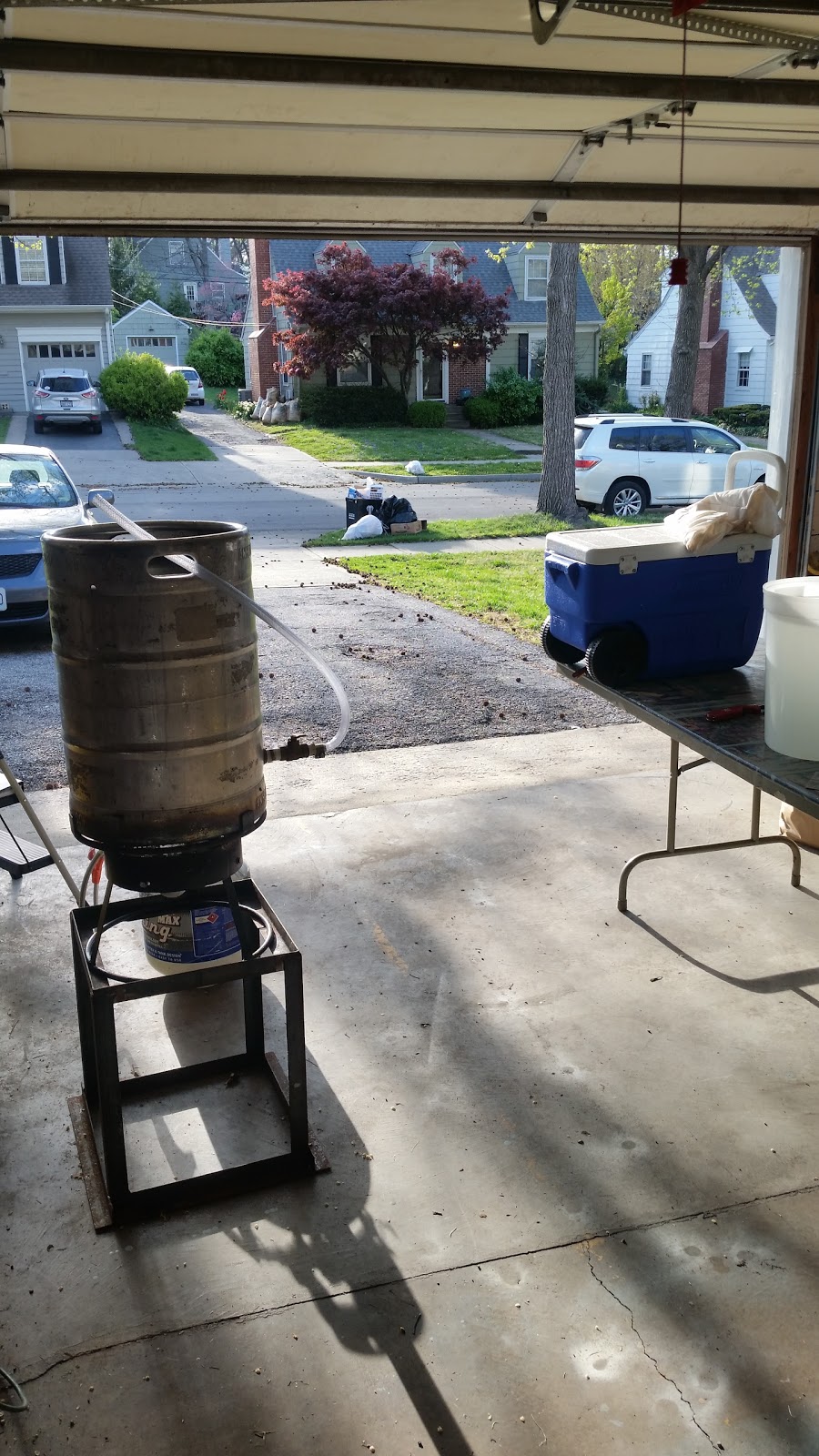
It was a beautiful night here in Kansas City.  A perfect night for brewing.   We set out to brew a 5 gallon batch of Hoptonite.   Our process was very straight forward.   A simple single infusion no sparge brew.   I personally love no sparge brewing.   We do our no sparge brewing in cooler mash tuns.   You have seen the pictures of the 100 quart mash tun that we use for 10 gallon batches.    But tonight we were using my 48 quart good ol reliable mash tun.   I've had it forever.  It still works fine. John preheated the mash tun with hot water as we ground the grains.

I made the water adjustments.  This was our first time using Beer Dust IPA blend. I'm sure it is a fine product, but it was not able to buffer to where we wanted, or reduce the pH adequately. Looking forward to seeing how it impacts the finished flavor of the beer.  So we used some acidulated malt, and some Five Star 5.2.  We nailed our pH.   Well ok, not nailed, but pretty damned close.

Our hops were provided by the awesome people at BSG.  We got to try their small packaging, and let me tell you,  it is every thing they say.  These are the freshest hops we have used... ever.  When you are making a hop monster ask for small packaged hops.  The major hop companies have them.  Your LHBS can order them for you.

Our grains all came from Cargill.  Cargill malts are fantastic.  I am definitely a fan.  We use grains from Rahr / BSG and Cargill.   I know when I stick with these companies, I will get consistent quality. Tonight, our base grain was Cargill 2 row pale.  We had heard rumors as to it's quality taste and high extraction.  Wort samples were sweet, bready, nutty, and delicious.  Everything we heard was true.

We were targeting 152 F as our mash temperature.   After checking the grain temperature and doing a quick calculation on brewtoad.com, we knew our strike water needed 8.5 gallons of water to be at 160 F.   We nailed our mash temperature.  At dough in we briefly rose to 153 F, but after taking the pH we were at 152 F.  We lost only 1 degree during the 60 minute mash, another benefit of no sparge.   If you have never tried no sparge brewing, you really should.  There are just really very few disadvantages, and lots of advantages.

Consider the following advantages of no sparge.
  • Decent efficiency, we get about 77%
  • No dough balls - thin mash easy to stir
  • Easy partigyle.   If you want to make two beers in one day, this is the easy way.  
    • Make a high gravity wort, drain it, and then put new water in for your second batch.  You can even add new specialty grains for flavor and color.  
  • Easy brew days, no sparging, heating water for sparging, transferring water.
  • More "time" in your brew day to do other things. 
    • organize
    • clean
    • prepare hop additions
    • sample "Founders KBS!"


At the end of the mash, we opened the valve on the cooler and drained into the boil kettle.  The first addition of hops went in right then.  4 ounces of Centennial. From there on it was a circus of hops.  We normally put hops into a bag, but this time we decided to let them flow and move about freely in hopes of maximizing their impact on the beer. 

We use a dry erase marker, Tupperware, and disposable cups to organize our hop additions.    Organization is critical when brewing a complex hop monster like this one.  Fortunately Jake is kinda uber organized.  So he takes charge of getting the hops ready.   Tonight that was no easy task.  The photo was taken after a couple of additions had already gone in.  

The boil was an awesome sight and smell extravaganza.   The entire garage filled with an intense hop aroma.  Not the normal, hoppy goodness aroma, this was intense.  The boil was rigorous.   We collected 7.5 gallons of wort, and boiled down to 6 gallons.    Next time, we will use a paint strainer bag for the hops.   The wort was a chunky hop soup.  It has already settled, and we have the technology to deal with it along the way, a quality fermentation chamber.   We can cold crash with out moving our fermenter.  But if you don't have that technology, use a hop bag.

We chilled as always with our Jaded Hydra chiller.  To say that it is awesome is an understatement.  We wanted to get under 140 F, as quick as possible.  And then whirlpool for 20 M.   We definitely pulled that off.  We went from 220 F to 120 F in about 2 minutes.   Amazing.  After the whirlpool, we went from 110 to 67 in 2 minutes.   Just get a hydra.  You'll thank me.

The next step for this is a whole lot of dry hops.  We are estimating a  3 week fermentation on this one.   So first dry hops go in in a week.   The rest of the dry hops go in the day before we begin the cold crash.   This is, as you may remember a real key to getting the hop flavor and aroma you want.

So in a month, we will be drinking an absolute hop monster. Drinking it along with august hyppo, and pliny the petulant.  I guess we are pretty well set with IPAs for the summer.   As you may recall we also brewed up 10 gallons of saison recently.  5 of which will be ready soon.  And saison is great summer beer.   Half of the batch was pitched with a sour culture, so it wont be ready for a year.  Up next for the group is probably the PIVO pilsner clone, with a partigyle IPA.  We have the grains, and the hops so why not?   I know at the high heat of summer our attention will turn to fall beers, a Festbier, a pumpkin ale (I know, I know, but the girls love them), browns, and stouts.

UPDATE 4/13/2016 - Hoptonite had a blow off of epic proportions.  Mark Anthony and I went to Johns to bottle up the Pliny the Petulant, and discovered a foamy hoppy mess in the fermentation chamber.  It took us (mostly MA) over an hour to clean it up.  So, use a blow off tube people.  Smells like intense hops, cant wait.


Saturday, March 12, 2016

How to make a ridiculous dIPA; Part 3 Recipe design. with BSG Hoptonite dIPA

So now it is time to apply what we have learned in this series and design a ridiculous double India Pale ale.   Our goal is not to clone any particular dIPA but rather to be inspired by some of the dIPAs that we love. We are not nearly as concerned with IBUs as we are with hop flavor and aroma.  IBUs are a theoretical measurement of bitterness.   We want the beer to be bitter, but we are more focused on hop flavor and aroma, and definitely a tongue stinger.  I, for one, think this is a fundamental characteristic of a dIPA.  We want loads of hop flavor and aroma.  We want those aromas to be herbal, pine, citrus, black pepper, and a touch of stone fruit.   Notice I didn't say woody, earthy, floral or grassy.   Those are characteristics we associate with an English IPA.   We want the color to be very light for a dIPA 7.5 to 8 SRM.


Wowser, that is a lot of want's and things to consider.  So let's break them down and analyze them one at a time.
  • We want the beer to be bitter -  We have learned that IBUs are a measurement of bitterness not hop aroma or flavor.  A beer that is 70-80 IBUs can be intensely hoppy.  But we promised you a hop monster. Were shooting for 135+ IBUs.
    • We have learned that many brewers prefer bittering hops low in cohumulone to get a less harsh bitter.   So We will be using Nugget Centennial - more later.
  • We have learned that by choosing hops with certain oils and protecting those oils by not exposing them to isomerization, and boil off, we can maximize our hop flavor and aroma.
  • We have learned that we have to focus on certain oils to get certain flavors.   In our case those oils are high in Myrcene and Linalool, and have a fair amount of Humulene and Carophylene.
  • We will need a decent bittering charge to get our IBUs up.
    • When you hop the heck out of a beer and have no bitterness, it just kinda seems mildly fruity and citrusy on the tongue.  That isn't what we want here.  
      • We made an all late addition citra IPA.  it was... meh. No balance just citrusy and stone fruit.
  • We will need a mid boil addition to up the bitterness more and get some midrange flavors.
    • Otherwise our beer can taste like it has a hole in the middle.   Bitter, but not lingering, and then whamo! aroma and flavor.  We want flavor and aroma all the way through the pallet. This is really common with lots of commercial american IPAs
  • We will have some flame out additions in our batch, but remember we have a jaded  hydra chiller and can easily control how long the oils are subjected to high heat. If you do not have the ability to chill rapidly.  I would suggest chilling to 140 F, then adding the hops for a 20 minute hop stand. 
  • We will be using 2 charges of dry hops in this recipe.  
    • One large charge of dry hops during active fermentation to expose the oils to bio transformation.  We want the transformation of the linalool into citronella 
    • One smaller charge of dry hops right before bottling to protect the oils from bio transformation during active fermentation. 
  • The hops we have selected were generously provided by BSG.  BSG is freaking fantastic.  They also have a small packaging program that keeps hops fresh.   Ask for BSG.
    • Side note:  They are the force behind many of the grains and hops you already use.  
    • Additional recipe support was also provided by the great people at BSG.  
  • The hops we have selected are
    • Centennial
    • Nugget
    • Galaxy
    • Cascade
    • Citra
    • El Dorado
    • Mosaic
  • Our hops came in 1 ounce  oxygen evacuated packages from BSG.  Your local home brew store can order these for you.  Our hops were shipped cool, and have been stored in the freezer. 
    • If your local home brew store does not have oxygen protected hops, and you are brewing for contest, or just trying to make the ultimate batch.  have them order these for you.  Both of the great hop providers, BSG, and YCH Hops can provide these for you. 
Again, we didn't want to copy another recipe exactly.  We wanted this to be our own Counterbrew / Turkey Creek / Mynd Spyn / Borders Brewing Adventure recipe.  Sure we could have just copied Pliny the Elder, or Headdy Topper.  And let me say for the record that is a fine thing to do.  I personally love Pliny the Elder.   I make it a lot, a couple of times during this writing of this blog. But this is our beer, based on our new and deeper understanding of the hops.  It is our hope that this new understanding creates a fantastic beer.

But now comes the hard part.

Figuring out the additions, the times, and the processes.   For that we turn to two sources to which I am proud to introduce you. (see I can use correct grammar)  First,  ScottJanish.com  hop oil calculator.  Scott is a great guy and very cerebral.  He has taken the time to build a free online hop oil calculator.  We have been testing it, and the predicted results match very closely the final product.  Now, you should know our hop bill doesn't fit into scotts calculator very well.  We  are using some hops that have not made their way onto the calculator yet.  No problem.  Not only is Scott cerebral, he is also a good guy.  He helped us choose the closest substitutions for the sake of his calculator.   The end result.  We will kinda know what the beer will taste like before we brew it.

Second, is good ol' expert advice.  One of the great things about home brewing is you can turn to people in your club, your LHBS, and to industry guys for help.   We will be planning our recipe using Brewtoad.com and Scottjanish.com.  And then sending our recipe to the experts at BSG just to make sure what the computer is spitting out will match what experience and expertise indicates.

ScottJanish.com is a beer blog.  Scott has done the research for you.  On ScottJanish.com you willfind the very best commercial clone recipes on the net.  A list of the top 200 beer blogs by reported traffic.  (Sadly we haven't made the list yet, but were almost there.) A list of great home brew recipes.  A hop substitutions engine, which is ever growing and expanding and, last but certainly not least, a hop oil calculator.   I don't design hoppy beers any more without consulting scottjanish.com.   The first beer was our hoppy wheat.  The hoppy wheat was barely posted about.  But we designed the recipe using the hop oils calculator, and as I sit here enjoying one right now, it occurs to me, the engine was right on the money.   We were trying to make a hoppy, citrusy wheat beer with some pine notes.  That is exactly what the engine said we would get, and that is exactly what we got.

But designing this recipe is a little more challenging.  The hop oil calculator does not have every hop yet,  Scott is doing his best, but remember this is just an amateur home brew blog. Not amateur in appearance or performance, just in the fact that it is not Scotts full time profession.  Since we were Using some hops that are not in the calculator yet, we had to find the closest substitution hop and plug that in.

When I first put the recipe in I was convinced of a hop schedule that featured Nugget as our bittering hop.   Nugget fit the bill.  I was sure of this fact.  But, I have come to trust Scott's hop oil calculator.  And when I put in my hop bill I got something that looked like this...Mild and pleasant with spicy floral tones.... what the what?   I'm trying to make a tongue stinger.   A tongue stinger that features very lemony, citrusy, pine, and black pepper tastes.  Here was my first attempt.

That is not what we were trying to do.   Mild and pleasant?   What is this the Lawrence Welk of beers?    We want interesting and cool.   We want flavors you can identify when you drink the beer.  But that is the cool thing about ScottJanish.com.   It allows you to test your recipe before you brew.  And based on the knowledge we have accumulated about hops, you can adjust your recipe.  Which I did.  Here is the second attempt.


Citrus and lemon notes with cedar, pine, floral black pepper and subtle green melon.  "Hello! yes please Ill have two of those, and get the dame a cosmo please, thank you!"  That is exactly what we wanted.   So that is what we are going with.    Just to make sure, before we brew, we will be running this by some experts at BSG.  But I think you all get my point.  What a cool resource.  One little change.  Changing the initial bittering charge to Centennial makes all the difference.  And isn't it cool that we live in a time where we don't have to just keep making the same beer over and over to figure that out?
So now our final recipe looks like this.
5.5 Gallon Batch.   Yield 5 gallons.
OG - 1.081
FG - 1.012
ABV - 9.1%
IBUs - 142 - yup 142 percieved IBUs but total AAUs of 160.85  (Pliny is 199 percieved IBUs and 152 AAUs)  So this is an insane hop monster.


The mash is a simple 60 minute rest at 150 F.    We will certainly do a no sparge for ours, but you brew it however you want to.  You could even make this as an extract.  There is so much hops in this that you really wouldn't notice much of a difference.   We wont be mashing out, or sparging, or step mashing or anything complicated.  Just straight forward hop attack.   That is it.  Nothing more to this one.   It is all about the hops.  We will be turning on our Jaded Hydra right at after the flame out additions go in.  We will be under 140 F, in under 2 minutes.  The 2 day dry hop is not a typo.  For the final dry hop we don't want to expose the hops to any yeast activity.

Next stop Brewing the beast.   But before we brew, remember we are running it by our experts.

So that is it sports fans.   A true hop monster.  But a hop monster developed with thoughtfulness and technology.   I am not saying this is the final version of the recipe.   I am sure we will make adjustments and modifications as we brew this beer.  But for now, this is our version of a double IPA. The brew day photos and videos will have to wait a while. As we are all very busy right now.   With family coming into town, work travel, church, and school activities.   I for one can't wait to brew this beer.   We will also be making my "by Grace" IPA in the near future (the best IPA I have ever tasted, an entire 5 gallon batch disappeared at just 2 cast parties)  and John's cream ale.  It is a fantastic summer beer. Thank you for your comments and questions.   I hope you will also brew this beer, and tell me what you think of it.

If you need an extract version of the recipe.  Just substitute the entire grain bill for 9.9 lbs of Light Liquid Extract (not pilsen or Maris Otter, just standard extract) and 2 lbs of extra light DME.   We are working with a home brew supplier to bring you all pre packaged versions of our recipes.  More on that to come soon.

UPDATE:  The good folks at BSG think our recipe looks good, and want to try some when it is done. We'll make sure they get to.

UDATE 2 Hoptonite will have to wait for a couple of weeks.  Easter is coming fast.  We have convinced our SWMBOs to let us brew on Holy Saturday, but it has to be fast.  So were doing a 10 gallon no sparge Saison.  Hoptonite will not be a fast brew day, every detail will be checked and re checked when we brew the monster.

UDATE 3 Hoptonite is about a week old.  It is chugging away in the FC.  The whole basement smells like hops.  We had a slight blowoff, and by slight I mean it took over an hour to clean up, so use a blow off tube and a large bucket.    Cant wait to taste it.

Wednesday, March 2, 2016

How to make a ridiculous Imperial IPA... Part 1 the pitfalls

Ok, here it is, the series you have all been waiting for.  The big one.   How to make a ridiculous double India Pale Ale.   This is the first in a 3 part series on this topic.  Part 1; the pitfalls, Part 2 Hop Oils and how to use them, Part 3 The Counterbrew dIPA recipe "Hoptonite".  I wont bore you with too much information and history about dIPAs.   But give me just a little leeway.   Until 1974 American beer was bland.  Bland, bad, yellow, fizzy lager. And not even great lager.  Then Fritz Maytag of Anchor brewing said, enough.  He came out with an English style pale ale hopped with Cascade hops, called Liberty Ale.   Liberty Ale was off the charts hoppy, clocking in at a reported 31 - 35 IBUs.  In a world where most beers were 12 to 16 IBUs, this was a game changer.  Fritz was soon followed by Ken Grossman of Sierra Nevada and his gift to the world, Sierra Nevada Pale Ale.

Vinnie Cilurzo the father of dIPA
and probably still the best brewer of the style!
But the world really changed in 1994 when a young brewer at a winery named Vinny Cilurzo came out with a high alcohol, high IBU beer called... Pliny the Elder right?  Wrong.... Blind Pig actually came first and is widely considered the first double IPA.   He took his IPA,  doubled the hops, increased the malt bill by 30%, and kept dry hopping  for a year while storing on oak chips.   And the revolution that was preserved by Anchor, Minhas, and Frankenmuth, and fueled by Boulevard, Sierra Nevada, Stone, and others got the turbo charge it needed.  The Double India Pale Ale, or Imperial IPA.

So, double India Pale Ales are a bit of a misnomer.  They are an American invention.  They are incredibly hoppy.   Believe it or not they are easy to make taste decent.  But really hard to make taste incredible.  This is why they are so very popular with home brewers.   Even if you don't absolutely nail it, it will still be pretty damned good.

But today, for this day only,  we here at Counterbrew will break open the secrets of making a great double India Pale Ale.   We will explore the pitfalls, we will explain techniques, and we will give some good guidelines to follow when making a dIPA.  At the end of the series we'll make a great dIPA and post all about it.

First the pitfalls.

many, many aftershool hours were wasted playing this
iconic game. Good Ol Atari, and Activision!
Guys get excited when they are making a dIPA, and really why shouldn't they?  A good dIPA is something we all long for.  The ability to create one gives a brewer great satisfaction, and pride. Sharing it with other brewers gets a brewer respect and a bit of brew geek glory.   But there are potential pitfalls to avoid when making a dIPA.  Today we focus on the pitfalls.


  1. Over complicated grist! -  Remember it is just a beer. You do not need 14 types of grain.  You do not need organic Himalayan spelt, malted by monks in a temple.   Keep your grain bill simple.  We here at Counterbrew (mostly me and John) have examined winning dIPA recipes from all over the internet.   Most winning recipes we have examined have no more than 4 grains.   Almost always those grains include pale ale malt and dexterine malt.  Often they include a crystal grain 20 to 40.  It is the attention you pay to the mash, and your skill as a brewer that will determine your mash quality, not some freaky ingredient.  
  2. Over complicated hop bill -  dIPAs tend too get muddled when you use to many hops, or you combine your hops carelessly, or you do not have a good schedule for adding your hops.   Muddled is a term that means... the hop flavor is there, but it is not definable, it's all mixed together.  The individual flavors offered by the hops can not be identified.  They have just kind of mixed together into a big conglomeration of hoppy goodness.   Still delicious.   But not at all what you want from a world class dIPA. That muddled taste can be what you want sometimes, especially in a pale ale, but not in a ridiculous dIPA.  
    1. A good rule of thumb is 1 flavor or aroma hop at a time, separated by 10 to 15 minutes.
  3. Over pitching yeast - yes over pitching yeast.   There has been so much focus in recent years on proper pitch rate.  Some of you missed the point.  Proper pitch rate, not ridiculous over pitch.  I recently fielded a question from a guy who put a 1 gallon starter in a 5 gallon batch of 1.050 beer.   He wondered why it didn't attenuate... duh!  Because it didn't need to attenuate.   The colony was already at its desired healthy population level.  Yeast only "eats" sugar to have energy to reproduce and colonize.  The population was already at its maximum density.    Remember yeast only "wants" to survive.  When the colony is healthy and full it is genetically coded to move into a "maintenance" cycle.    (Not exactly how it works, but a useful way to view things)
    1. Use a trusted calculator and stick with what it says.  I like homebrewdad/brewunited yeast and starter calculator.   I also like the pitch rate calculator on Brewtoad.  It never lets me down.   
  4. Underpitching yeast -   I feel like this has been covered very thoroughly on this blog.   But underpitching can create off flavors and keep the beer from attenuating completely.  dIPAs are supposed to be crisp.  The sweet flavor, if there is any, comes from the hop oils and sugars in the hops (yes there are sugars in hops).  A dIPA that is too sweet is cloying and gross. 
  5. No temperature control -  Once again if you spend $2000 to $5000 on a wort production machine and you can not control the temperature of your fermentation, you missed the point!  Many of you fancy boys would find our equipment ghetto.  Many of you new and intermediate brewers would be blown away by our toys.  But any of you who can't control fermentation temperatures would be jealous.  John has a Cold Chamber, and a Hot chamber (for sours and saisons), I have an ale chamber and 2 individually controlled lager chambers.  You see?  we didn't miss the point!  You must be able to ferment at the correct temperatures for your yeast.  Period!   There is really nothing more to say on this topic.  
    1. If you do not have temperature controlled fermentation, I strongly suggest you use a yeast that is very forgiving, US05.  WLP001  WY1056.  
    2. If you can't control fermentation temperatures, this should be a high priority, right after full volume boil, and before switching to all grain.  
    3. By the way, don't even talk to me about specialty liquid yeasts (other than those I've mentioned above, if you can not control fermentation temperatures)
  6. Chilling too slowly - As you all know I sometimes make batches of "no chill" beer.   But you may have noticed, I never do this with hoppy beers.  No chill works fine with a house cream ale.  It doesn't work with hop monsters.   You must chill your beer quickly.  If you do not have an immersion chiller it may not be time to try this recipe yet.  (Or message me and I will scale it down to 2 gallons that you can chill in your kitchen sink with ice)
    1. With a dIPA it is critical to get the entire batch to under hop isomerization temperature quickly.  We believe an immersion chiller is the best option for this.  We believe Jaded makes the best chillers.   It is the only method by which you can quickly bring the entire volume of wort down at once.  
      1.  Why is this so critical?  Hop Oils continue to isomerize above 140 F.
      2. What the heck is isomerize?  Isomerization is the process by which a molecule rearranges its atoms due to an outside force like temperature.   Still the same number of atoms but they are in a different arrangement.   It literally changes into a different molecule.   With hops exposure to high temperatures for long periods of time causes the oils in the hops to change.That is literally how we use hops in beer. The longer the exposure the more the change.
        1. Change from the bright herby, spicy, citrusy, etc... to just plain ol bitter.  
        2. You want some bitter in a dIPA but you also want clearly defined hop flavors.    
    2. If you can recirculate you could use a counter flow chiller, or a plate chiller to bring the temperature down as quickly as possible while recirculating. 
  7. Lack of attention to detail during brewing -   This is the number one thing brewers do wrong.  It isn't water chemistry, it isn't pitch rate, it isn't lack of temperature control.  It's not paying attention when brewing.  Believe me I understand, family, friends, other chores, a great game on television, a Doctor Who marathon, and Verdi's Othello (I love opera) have all distracted me on brew day!  But when you are brewing a dIPA there is no room for distraction. (Really when brewing anything there is no room for distraction).  Keep a brew day log.  Put every step of your brewing on the log.  Follow it.   Basic brewing has a great log book. 
Those are the common pitfalls when brewing a dIPA, and really almost all beers.  Some beers are more forgiving, some are less forgiving.  But in general these are the pitfalls of brewing a great dIPA, and good practices to follow with any brewing session.  So as you plan your recipe, don't just plan the ingredients take the time to plan out everything.   It will dramatically improve your brew day. 

In our next installment we will be looking at hop oils... what are they, and what flavors do they create?  How can you use them best... notice I did not say maximize them... Use them best...