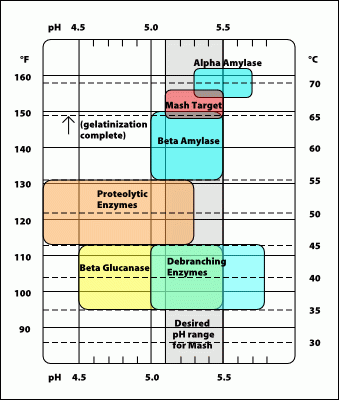
 The most common questions we field on this blog are related to step mashing and I know it can be confusing. We clearly have touched on something with this topic. To be honest I am surprised that more of you don't know more about step mashing. After all, in the old days we had to step mash. We have written about this process a lot, but it is important to go back and clarify some things and to review what we have learned already.
In this modern home brew world you have been taught that mash temperature is a dial that you can turn up or turn down in order to create the wort that you want to create. Turn it up to create more mouth feel; turn it down to create more fermentability. You have been told that modern well modified malts do not need a multi step mash, and that it is kinda a waste of your time to do a 2 hour multi-step mash... and I am here to tell you... all of those statements are kinda true. Kinda, but not entirely true.
 "What? OK, once again I got on your blog and you are giving me almost truths, and cloistered mysterious statements, just tell me what to do..."
Ok, I will tell you what to do. The first thing I want you to do is, quit looking for absolute procedures and rules. Intstead.... Learn. Brewing is 45% cleaning, 45% learning, and 10% brewing. So the most important thing to do right now, as you are reading this blog, is learn. Learn about the major enzymes that we as brewers use to control our mash and get the desired results. Learn that there are so many more enzymes at work in your mash than just alpha and beta amylase. Learn that enzymes work in temperature ranges not at absolute specific temperatures. If you are determined to do only single step mashes... well then go read another blog today. It wont hurt my feelings. I've said it before I know an award winning brewer who mashes everything he brews at 150 F. (65.5 C). Doesn't matter what style.... 150 F. He makes grain or sugar additions to make up for what he is not getting from the mash. Who am I to say he is wrong. So learn what works best for you. For me, I enjoy step mashing and the benefits that it yields.
Here is the truth, as I understand it. When you brew with modern well modified malt, you do not have to do a step mash. The mash will convert just fine at the temperatures you are accustomed to using. Higher temperatures will produce a wort with slightly more mouth feel. Lower temperatures will produce a wort with slightly more fermentability. But only SLIGHTLY. As Marshall Schott, the Brulosopher showed us on Brulosophy, the difference between a wort that finishes at 1.005, and 1.014 is not reliably perceived by the human taste mechanism.
 Here is why. When you are only using alpha and beta amylase to create mouth feel, or adding grains with more proteins, you are asking sugars to do the job of medium chain amino acids, and sugar isn't very good at doing this job. That is the problem with this approach... you can't make a highly attenuative beer with a luxurious mouth feel. Don't argue this point, it cannot be done, once again if you don't believe me read the Brulosophy article linked above. The human taste mechanism can not perceive the difference. As an example, I will present our Desir Tripel. Desir is a 1.084 OG beer, It drops to 1.014. That is 83% attenuation. But when you drink it, it is luxurious and rich. The last batch was almost too rich- almost cloying. Comments from random tasters and BJCP judges universally called the batch sweet. And obviously, at 83.33% attenuation, it wasn't sweet at all. But the perception of sweetness associated with rich mouth feel pervades our community like a cancer. (Rant warning! We used to know better. But we have all been brewing single mash rest so long, that we have forgotten what a rich beer tastes like. The association of mouth feel and sweetness is a problem in our hobby. And that is because of single step mashing. But I'm not bitter.). Next time we'll shorten the protein rest and increase the hops slightly.
So the temperature of a single step mash is one way you can create the beer you want. But an even better way? Multi-step Mashing. But to multi-step mash you have to know what the enzymes do, and how they can help you make the beer you want. And to do that, you have to know what enzymes are, and a little bit about how they work.
What is an enzyme?
 |
| Representation of an Enzyme |
More than one enzyme can be active at any given time. And this is a really good thing. That means more than one process can be going on at a time.
A catalyst is just a name for a component of a biological or chemical reaction that creates a change of some kind. For our purposes, the proteins are almost always breaking things apart. By understanding what the various enzymes are and what they do, you can truly fine tune and control a mash. Remember, brewing is not about following some exact protocol that you read on some crazy man's blog. Brewing is about learning- learning your system, and learning how things behave on your system. It may shock you that when I brew a hefe on my system I know that my protein rest needs to be 32 minutes. Not 31, not 34. 32 minutes. Why? Because that created the exact taste I wanted, several times in a row, at my old house, with my old water profile. Now... that I have moved, all bets are off. I'll have to re-learn what is perfect at my new place. For our BDSA at John's house, I think we all agree that 30 minutes was a little too much, but 20 was not enough. So next time we will be extending the protein rest to 25 minutes and seeing how that tastes. See? it is all about learning... and cleaning...
So the important question, what enzymes are we concerned with in brewing?
The ACID rest: Temperature Range 95 F to 113 F, (35 to 45 C0 Active Enzyme Phytase, Glucanase
Ok, during an acid rest there are two potential enzymes working: Phytase and Glucanase. (And honestly you can pretty much ignore one of them). Phytase works actively on a molecule found in grains called phytin. It creates phytic acid which can and will lower your mash pH. But it takes a long time (60 minutes) and really only does well in soft water. If you ever want to do a true, rustic brew with minimal additions, this is the way to lower pH without chemicals. It is also a pain in the ass and takes forever. It is much easier to add some Acid, or Acidulated Malt to the grist.
The real reason to do a rest at this temperature is to break down beta glucans (gummy gelatin gunk). Beta Glucan is a gummy carbohydrate that surrounds the starch molecule of a grain. They get in the way of the amylase and other enzymes, and glucans are the chief contributor to chill haze in your beer. A brief rest at these temperature ranges will allow glucanase to break down the Beta Glucans. End result- clearer beer and slightly better conversion. Especially important for wheat and rye. When you do a Beta Glucan Rest your wort will be very milky, that is normal and good.
The PROTEIN rest: Temperature Range 113 -138 F (45 to 59 C), Active Enzymes Proteinase, Peptidase

Proteinase works at 131 F to 138 F (55 to 59 C) and is thought to reduce haze without reducing body. It breaks long chain amino acids into medium chain amino acids. You want medium chain amino acids in your beer. They improve the mouth feel of your beer. They can create a luscious beer that isn't overly sweet. I for one really appreciate this quality in a beer. If you are looking for clarity, without a loss in mouth feel, you should consider a mash rest that maximizes Proteinase action (around 136 F).
Peptidase works at 113 F to 128 F. (45 to 53 C) Peptidase breaks medium chains into their components. So if you want to express maximum esters or phenols in a Hefe weis or in a BSDA, you really should consider a protein rest around 115 F. The key acid you are trying to maximize is called Ferulic acid. A Peptidase rest will help you maximize it's availability. Then all you have to do is use a yeast that is POF+ or phenolic off flavor positive. And do not worry, if you are not trying to create these esters, just choose a yeast that is not POF+.
Review: what we have learned so far is that a rest at 113 F (45 C), followed by a rest at 136 F (57.5 C), would be a really good idea if you want to make a very clear beer with good mouth feel and still have a highly efficient mash.
The Saccharification Rest; Temperature range 132 F to 162, (55.5 C to 72 C) Active Enzymes; Beta Amylase, and Alpha Amylase
Most of you are already familiar with the Sac rest. You already are using temperatures in this range to craft your delicious home brew. This is the main activity going on in the mash. The main thing we are concerned with- conversion of starches to sugars. And it happens more quickly than you may think. Most amylase conversion is done with in the first 25 minutes. But if you want to maximize conversion we strongly suggest you stir your mash every 10 to 15 minutes and rest for at least 45 minutes. We have used this approach to get over 90% efficiency on Brew in a Bag, with a sparge rinse, multiple times.
 |
| Beta Amylase |
 |
| Alpha Amylase |
 |
| An enzyme after mash out. |
The MASH OUT rest: Temperature range 168 F +, Active Enzymes - none.
The point of the mash out is to turn off the enzymes. The brewing enzymes are, in fact, proteins. Like all proteins they are trying to bind to something; trying to work on something; trying to interact. By raising the temperature above 168 F, you are damaging the working parts of the enzymes and basically turning them off. This is called denaturing proteins. They can no longer act on the starches and proteins. By doing this you create a less viscous ( Less thick) wort and a wort that will flow more completely and with more of its desired sugars and flavors into your boil kettle. Again this is a fact, there is no reason to argue it. You can argue whether or not it is worth it, but you can't argue the science behind the reasoning. So I took this from the previous post. Here are some time tested proven step mash programs. I have used them all. They all work. And yes, they take longer. If you have an automated system then these are a walk in the park for you. If not, you'll have to do some math. Fortunately Brewersfriend has a great infusion calculator for you to use. If you are infusion step mashing you will need this calculator open on brew day.
If you are not familiar with infusion step mashing, you should get your self familiar with it. Basically you start with a thick mash, and add boiling water to the mash to raise the temperature. It is actually faster than most recirculating mash systems. Boiling water additions are faster than a heating element.
A Step Mash for clarity and body.
100 F for 20 minutes
134 F for 20 minutes
145 F for 30 minutes
155 F for 20 minutes
168 F for 10 minutes
A Step Mash for maximum phenolic expression.
100 F for 20 minutes
113 F for 35 minutes
134 F for 10 minutes
150 F for 30 minutes
168 F for 10 minutes
A simple step mash for maximum extraction of sugar
100 F for 20 minutes
150 F for 45 minutes
168 F for 10 minutes
Step mash for dry beer - dry stout & dry lager like ales
145 F for 30 minutes
152 F for 50 minutes
158 F for 30 minutes
168 F for 10 minutes


