Showing posts with label rant. Show all posts

Wednesday, February 3, 2016

End the Arguing... No more trolls

It's time to end the argument.  We all won anyway.   At the end of the day we all had beer.  Beer to share, beer to enjoy.  Yummy delicious beer.   So quit freaking arguing over how to make it.  Sometimes I feel like a broken record.  But here we go again. 
  • Wort production method doesn't matter
  • Barley doesn't know how it is being mashed
  • Someone else's method may be better, or worse than yours
  • The important thing is, that it is fun, and that it makes great beer. 
  • If you spent $1000 on wort production before fermentation temperature control, you missed the point!

So is time to quit telling others that the way they brew is wrong.   Or that they are less of a brewer because they use a particular method.   You aren't more of a brewer if you use 3 or 4 vessels, you aren't more of a brewer if you use the latest state of the art eHERMS or RIMS system with a vent-less water heater and a bluetooth controller (although that is pretty cool)  You aren't less of a brewer if you no sparge in a cooler, or biab.  Enough. already! If you make beer, you are a home brewer.   

What prompted this latest rant?  A troll. A lecherous wart covered, dung eating troll with tusks and leathery skin.  The kind of beast that should be driven out of the kingdom (summon Arthur and the knights)... the internet troll.  

You know the type,the type who changed his on line name to "mstrbrewr" after his first Mr Beer kit.   Since then he's managed to brew a couple more times, but he has read and committed to memory everything.    His un welcome answers to questions are straight out of the books he's read. But not from his vast practical experience.   He's full of knowledge and passion for this hobby,  and he just had to share it all, now! Share it from his lofty position on the old couch in his mom's basement. 

Tonight a guy on one of the forums made a pretty innocuous comment about 90% efficiency with  brew in a bag.   The conversation was pleasant, until Tommy Troll chimed in.  He explained to all of us that "this was not possible".   He quoted Palmer, he quoted Fix.   What he did not do is show any compassion or share any experience.   He attacked.   In his dully honed opinion, "only fly sparge  could get a person to 90%."  Despite several people letting him know they had done it several times.   He then proceeded to explain that biab is "much less efficient". And I had had enough.  He was desperate to display his knowledge. To establish his prominence in the brewing community.  He is, after all, the new brew sage we have been waiting for.  

So here we go again.  There isn't one right way to brew.  Even commercial brewing is changing, many do not even have HLTs or Grants any more... opting instead for instant water heaters.  If you open your mind you'd know that.   My team and I are building a 1 BBL BIAB Recirculating Mash system.  You are welcome to use it (for a nominal fee) when you need to brew big, Are you really going to say no, because it's BIAB?

I am a classic example, and I was a classic fool.   I resisted biab for years.   I knew beyond a shadow of a doubt that my fly sparge system was the most efficient way to make beer.  I knew my system so well that I could coax 78-80% out of it.   But on a cold and snowy day I joined a friend who was brewing in his kitchen with an electric turkey fryer. All grain BIAB.  Winter / Kitchen brewing was something I couldn't do.   We got 83%.  I checked, and re checked.  I tasted the mash, perfect.  I rechecked the mash extraction efficiency.   There was no where to hide.  I had to admit it worked.   I now get 82.5% efficiency consistently with brew in a bag, on my kitchen counter top.   But please,  yes. Explain to me how only fly sparge is real  brewing.   Because I was doing that before you were born. 


The world changes,  and we change with it.  By the way arguing about wort production... kinda misses the point.  I have correctly and precisely fermented average wort at perfect temperatures, and produced superior beer.  Once again malt has no idea it is being mashed.  Enzymes couldn't care less whether you biab, fly sparge, batch sparge, or no sparge.  After 3 or 4 years, of brewing you're ready to have really helpful experienced advice.  But not after 1 or two years of just reading and studying. Be kind. Be helpful, share your actual experience.  And remember almost everyone has read, and owns the books you are quoting.   If the real answer was in the book they would have found it already.   So don't sit around with the books in your lap trying to answer questions.    Believe me we've all read the books.   Ask questions.  

And finally, we don't need a new sage... but we could all use another beer loving friend. 

Thursday, November 5, 2015

HOME BREWERS! STOP COMPLICATING EVERYTHING!

Some people could complicate making toast. And unfortunately many of them are in our hobby.  I Just saw a combination eHERMS recirculating biab, gas kettle recirculating mash system.   What the what people...So once again... I'm compelled to act like an angry old man...

Mash doesn't know it is being recirculated.   And quite frankly, even if it did, it couldn't care less.  Mash doesn't know how it is being lautered. Mash doesn't need to be recirculated.  Enzymatic action works whether or not you recirculate.  You can easily agitate your beer with a spoon.  

Enzymes work whether or not they are recirculating.  Yes exposing more surface area to enzymatic action for a longer period of time will produce more conversion of starch to sugar. But again, temperature, pH, and grist size are far more important that recirculation.   Use the finest grist you can use.  Yes, even if it makes some flour, line your mash tun with voile fabric ($9.00 a yard at JoAnn).  You'll thank me.  That will do more for your mash than some $5000 brewing system.  

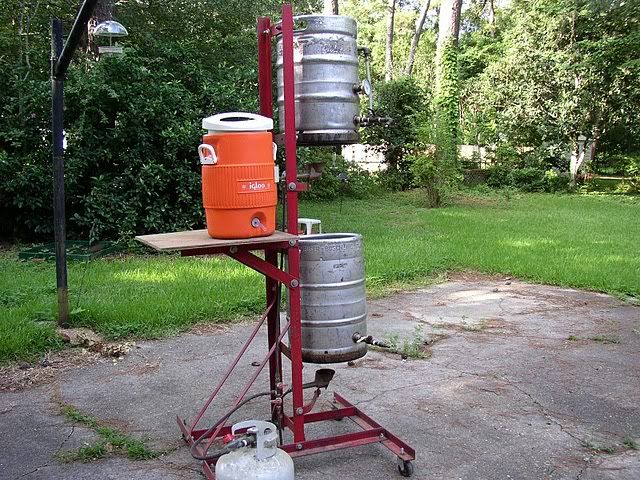
this system still works just fine, 
So once again, my best advice is Keep it simple.   A simple gravity system or a simple BIAB system will produce excellent beer.  If your beer isn't good, it is because your process, or recipe isn't good.  Not because your equipment sucks.   I learned from a guy who used aluminum pots, and plastic buckets.  His malty beers were the best I ever had.   If you complicated your brewing system, you complicated your sanitation regimine. There is just no reason for that.   If you improved your brewing system, you probably also improved your processes.  Why not just improve your processes?   Why not put your focus on sanitation and fermentation? Why not learn how to create a yeast pitch with maximum vitality? Why not learn how to decoction mash?  Why not learn about the hop glycosides, or the role of melanoidin in malt flavors?
Put your focus on things that matter.  Yes a pump is nice to have,  but it doesn't improve your beer.  And I only run water through my pump...water is easy to clean, wort is not.  Water doesn't tend to foster bacteria, fungus, or mold. 

this system also works just fine
People we are focusing too much on the creation of wort, when we need to be focusing on the sanitation, and fermentation of beer.  I know from my experience that an identical grain bills created with 3 different systems, 3 vessel Gravity, BIAB, and recirculating BIAB, come out nearly identical, with the 3 vessel Gravity system gaining only a slight advantage in conversion.   And the maltiness, and time savings of no sparge BIAB cant be beat for me, so that is what I usually do.   Plus with BIAB I can partigyle my grains into a partial mash batch.  So what is my real efficiency?  No idea, just know I'm getting two batches of beer out of each set of grains. (of course I can tell you my average efficiency is 81.9%)  But what is my real brewhouse efficiency when I get 10 gallons out of each grist?

So if you want to redneck engineer something please create something that makes sanitation, and fermentation better.   Please show me how to create a fermentation chamber that can have multiple temperatures in one chamber.  The best I've come up with is a lower overall temperature and heating bands to create different temperatures.  Please show me how to more easily control lagering temperature schedules.  Please show me how to make a carboy cleaner that makes sense and doesn't just spray sanitizer in a carboy.  Let's get a home brew hack for sanitation.   Show me how to make a carboy cleaner out of a drill and some car cleaning shammies.  Show me how to track the fermentation of my beer without exposing my beer to potential contamination. 

Look, do your thing and have fun doing it.  It's just home brew.  But it really doesn't have to be this complicated.

UPDATE:  This weekend we hit 84.5% with BIAB.  Now granted, it was a small batch, and they generally are more efficient, but still, 84.5%.   You're not gettng that out of an eHERMS system.   We didn't recirculate, we didn't use some fancy controller system.   We made sure our water pH was perfect, we made sure our strike was perfect, we crushed our grains very finely, we stirred every 15 minutes.   We used spoons to occasionally taste the wort.   (you did what?  well that just makes no sense...)  I'll write more about this technique later, but trust me if you can learn what the different tastes are and what they mean... you will become a wort whisperer. 

Thursday, September 3, 2015

Dumbest things I've read about home brew on the internet...

I love the internet.   Obviously I am a fan of blogging, and forums and chat rooms.  But,  you have to source your information carefully... Today I present to you some of the dumbest things I have read on the internet about home brewing.  Here are some examples to avoid,  with out names attached... I'm not petty, just a humble servant of home brew truth.

This is MOLD on a batch that was
supposed to be a sour.  It can and does
happen. ideal sour bacteria is probably
not floating around your kitchen...
infections - "let it ride man...it might be great"   first pet peeve... not every infection is a potentially good thing... mold will not magically turn into bret brux and create an amazing beer.  Mold is just mold...   Not every infection is safe... acetobacter is not something to be taken lightly.  I'm so tired of people posting infections that are obviously mold and having some one say... let it ride...   Best advice "if you didn't mean to brew a sour... pour it out... or take lots of photos and take it to your LHBS and ask what it is..."
for comparison sake, and to
end the silly arguments.
Here is a healthy Brett Pellicle.
I think you all get my point.  You just can't tell from a 2" photo on the internet.  It might be wonderful... It might be potentially dangerous to people with mold allergies, asthma, and other sensitivities.  So best advice is to go get some professional advice from your local home brew shop, or an extremely experienced home brewer, who brews sours.  And remember, even if it is an ok sour bacteria... The pitch rate of the bacteria is no where close enough to create what you want.  So if you are going to "let it ride"  I still suggest a trip to your LHBS to get some viable adequate cultures of bacteria.


tannins - "don't squeeze the bag...you'll extract tannin" listen to me round eyes... you are not strong enough to extract tannin by squeezing a grain bag...the extraction of tannins from barley occurs when a certain set of conditions are all present...and chief among them is a pH over 6 in your mash and sparge.   It is really hard to get your pH that high when brewing.   Especially if you are using pH stabilizer.so squeeze your bags biab brewers... get all that wonderful wort out of there 

dms - "if you don't boil for an hour or more... you'll create DMS"   You do not create DMS. The DMS precursor amino acid S-Methyl Methionine is present in all grains...it is necessary for germination. SMM is the DMS precursor, not some magic brewing dust in your boil kettle.  In a kernel of well modified malted barley it is only present in very very low levels. With well modified barley... there is very little risk of DMS.  If you boil hard for 15 minutes or longer.... there is almost no risk.  DMS fear is a hold over from the early days of home brewing.  Back then we didn't get grains that were fully modified.   Perhaps 75-80% of a bag of grain was well modified (meaning the acrospire had reached the top of the kernel) the rest were not there yet.  So there was a much greater risk of DMS.  I have tasted DMS beer... I doubt that most of you ever have tasted a beer ruined by DMS.  It is really rare now.  If you want to taste it get a can of cream corn and throw some hops and canned spinach in it mix it with a beer... that will be close.

diacetyl -  this one's a doosy... "if you ferment over 65 you'll have diacetyl every time"... WRONG FALSE... GO TO JAIL DO NOT PASS GO DO NOT GO HOME.  Here's another classic... "the amount of diacetyl is directly proportionate to the % of crystal and roasted grains..."  what the what...  Diacetyl is a normal product of yeast metabolism.   The amount of buttery, or butterscotchy character you get IS related to the fermentation temperatures. But 70-74 isn't a problem.  The good people at your preferred yeast vendor love brewing as much as you do, probably more,  they have worked hard to create and mutate yeasts that don't kick off a lot of alpha acetyl.   Alpha acetyl is the precursor, that is what becomes diacetyl.   Here is the good news... modern yeast absorbs and breaks down diacetyl.  That is why we ferment for 2-3 weeks minimum. The primary fermentation is usually done in 5-7 days, assuming good aeration and good pitch rate.   The extra time is for the yeast reabsorbing and cleaning up other less desirable flavors. Wyeast, White Labs, and Fermentis all have excellent resources on line...

BIAB isn't efficient... "I don't like BIAB because it is only about 65% efficient..."  No sparge BIAB may be less efficient than sparging methods.   But, no sparge 3 vessel is also less efficient than batch sparging, which is less efficient than fly sparging.   The truth is grains, enzymes, and flavonoids don't know if they are in a 3 vessel system or a pot on your stove.  Efficiency has way more to do with the brewer, and their practice than the system you are using... Unless you are using an automated single vessel system (they regularly run over 80%).  BIAB is no less efficient than 3 vessel.   But, and this is an important thing to remember, There is more going on in your mash than conversion of starch to sugar through the Embden–Meyerhof–Parnas metabolic pathway. Better efficiency does not equal better beer.

Worst Recipe Ever... and a common trend.  I see recipes all the time on the internet in various recipe forums for "partial mash" that have no mashable grains... ONLY BASE MALTS NEED TO BE MASHED,  A RECIPE ISN'T PARTIAL MASH UNLESS YOU ARE MASHING FREAKING GRAINS. Sorry, had to get that off my chest.   I have seen a recipe this week on one of the sites that called for... wait for it... 4 # of Black Malt,  3# of Chocolate Malt, and 10 # of Crystal #20... it was described as a sweet stout... uh...well... oh buddy no... just no.   I asked if he meant .4, .3 and 10# of stout malt?  he said no, they brew this all the time... so be careful on the free recipe forums.  There are some new guys, who have lots of enthusiasm, but no real knowledge yet.... Brewtoad is working to correct some of these problems, they are adding a feature to make sure that partial mash actually has base grain, and that there are base grains, or extract in every batch.

The moral of the story... educate your self.  Yes, have fun on the internet.  Read the blogs.   But double check the information.   I can't say I work hard to bring you cutting edge research... I leave that to the Brulosopher, Professor Brew, and Woodland Brewing Research.  But I can say I've been doing this a long time.  I don't know the things I know because I am brilliant (I am but that is another story).  I know these things because I have failed as much as anyone else and had to go to the LHBS and ask what I did wrong.  Or spend time in Dr. George Fix's book "Principles of Brewing Science"  That is all for now brew fans.   Keep on brewing and keep on sending your comments and questions...

What's the dumbest thing you have read about home brew on the internet... please no names or handles...

Lucas Cashman had some great comments, so I added them...

Autolysis... if you don't rack of the primary you'll get autolysis... So many reasons why this isn't a big concern for home brewers... Let's just say it this way... if you aren't aging a beer for more than 4 months in the carboy, Autolysis is not an actual issue for home brew.  The volumes of yeast are just not enough to cause this phenomenon in noticeable amounts.   Current Advice is this... unless you want to use the yeast cake for another batch... or you are going to age a beer (i.e. Barley Wine, RIS) don't rack it at all.

White Sugar makes a cider taste... this one is partially true.  White sugar in large % of your grist can give a cidery taste... but when used for bottling, or used to help dry out a batch... it won't.   Yeast will eat the simplest sugars first in the EMP metabolic pathway.  Glycosis is the conversion of 1 molecule of glucose into 2 ethanol and 2 CO2.  It is a process we can control with healthy adequate yeast pitch, temperature, and wort composition.  If you give the yeast a super simple sugar to eat, they will eat it fast , and they will kick off other compounds in the minor metabolic pathways, in order to eat it fast. But if you give them sugar after they have converted most of the maltose, glucose, and maltriose, fructose... you will extend yeast activity and help to dry out a beer...

Extract Beers are Twangy... too much has been written about this already.  So i will just say... Baloney.  They are not.  They haven't been for years.  The twang that you get from extract has to do with brewing experience and practice not the extract.   A well made extract beer is nearly indistinguishable from an all grain beer.  And a well made partial mash beer is often superior due to the advantages it has in terms of water chemistry and pH.  The reason I prefer all grain and partial mash is that to me they are more fun, offer more variety, and they cost way way less.